How Do You Know If Your Car Was Actually Fixed Right After a Collision in the Bronx?
Most drivers pick up their car after a collision repair, take a quick look at the body panels, and figure that if it looks good, it must be good. But that’s not always the case — and in a city where you’re merging onto the Cross Bronx Expressway or navigating the stop-and-go on Fordham Road every single day, driving a car that wasn’t properly repaired isn’t just frustrating. It can be genuinely dangerous. Knowing how to verify that your repair was done right — before you drive away — is something nobody talks about enough. We’re going to change that.
Why Most Shops Don’t Walk You Through the Work
Here’s a reality that surprises a lot of drivers: very few body shops take the time to walk you through what was done and why. They hand you the keys, point you to your car, and move on to the next job. That’s common across the industry, and it’s a gap we’ve noticed competitors in the area don’t address at all on their websites or in their customer experience.
At a shop that takes quality seriously, you shouldn’t be left guessing. A good technician — or at minimum a service advisor — should be able to show you the repaired panels, explain what parts were replaced versus repaired, and confirm that any structural or mechanical work passed a proper inspection. If they can’t do that, that’s worth noting.
What to Check Before You Drive Off the Lot
You don’t need to be a mechanic to do a reasonable post-repair walkthrough. Here’s what to look at:
Panel Gaps and Alignment
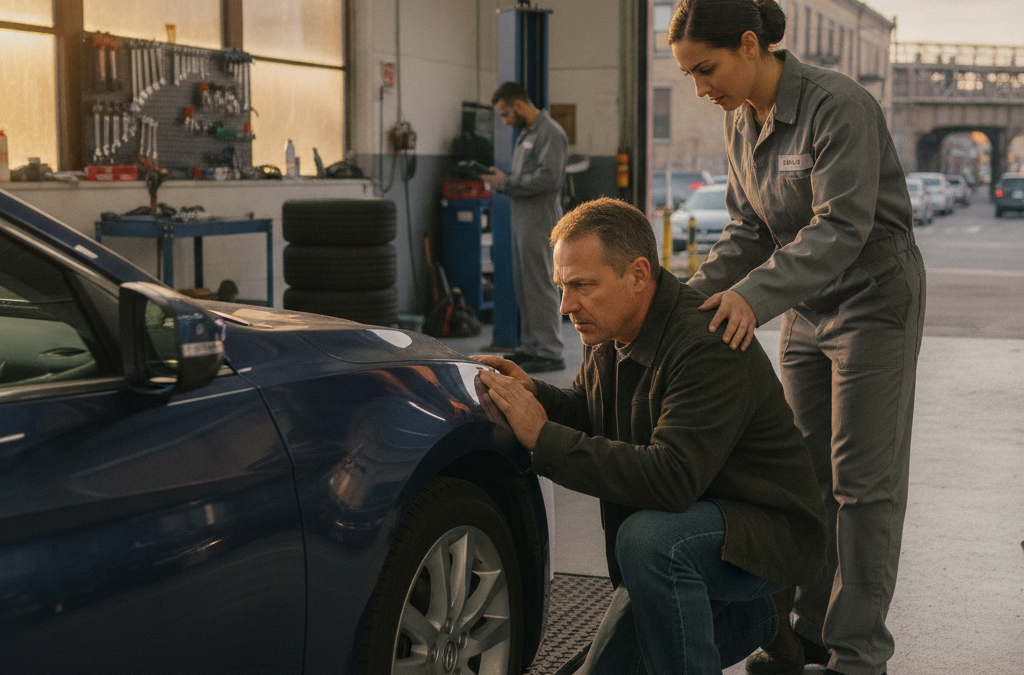
Stand back and look at the repaired area from a few angles. The gaps between panels — hood to fender, door to door frame, trunk to quarter panel — should be consistent and even. If one side of the hood sits slightly lower than the other, or a door doesn’t line up with the rocker panel the way it used to, that’s a sign something wasn’t put back together correctly. This is especially important after any front-end or rear-end collision where structural components may have been involved.
Paint Match and Finish
Walk around the car in natural light if you can. The repaired panel’s color should blend seamlessly with the original paint on adjacent panels. Look for differences in sheen, texture, or depth — especially in metallic or pearl finishes, which are notoriously harder to match. A slight color variation in direct sunlight is the most common sign of a rushed paint job.
Squeaks, Rattles, or Resistance
Open and close every door, the hood, and the trunk. They should feel and sound the same as before the accident. Any unusual resistance, squeaking, or rattling can indicate that the body wasn’t fully realigned or that weatherstripping wasn’t replaced properly. These details matter more than people realize — a door that doesn’t seal right lets in road noise, wind, and eventually water.
Test Drive Before You Sign Off
Don’t skip this step. Take the car around the block. If the steering pulls to one side, the car vibrates at highway speeds, or you hear something that wasn’t there before, bring it back immediately. These symptoms can point to alignment issues or mechanical work that wasn’t completed correctly — not cosmetic problems, but real safety concerns.
What the Paperwork Should Tell You
A reputable shop will give you a written, itemized repair order that lists every part replaced, every repair procedure performed, and whether any parts were OEM (original equipment manufacturer) or aftermarket. You have every right to ask for this documentation, and if a shop is reluctant to hand it over, that’s a red flag.
If your repair went through an insurance claim, you should also have a copy of the original estimate and any supplements that were added during the repair. Supplements happen when a technician opens up a damaged area and discovers hidden damage that wasn’t visible during the initial inspection. A legitimate shop will document all of that and update your insurer accordingly — not quietly skip it to finish faster.
You can learn more about how certified repair documentation and quality standards work at our manufacturer certifications page.
Why Certified Technicians Make a Measurable Difference Here
One of the things that separates a shop with I-CAR Gold Class certified technicians from a general auto body shop is the standard they’re held to during the actual repair — not just on the surface, but in the structural work underneath. I-CAR training covers proper sectioning procedures, welding standards, and material-specific repair methods that matter enormously if your car has high-strength steel, aluminum panels, or advanced driver assistance systems (ADAS) that need to be recalibrated after a collision.
ADAS recalibration is a big one that often gets skipped at shops that aren’t up to date. If your car has lane departure warning, automatic emergency braking, or backup sensors, those systems rely on cameras and radar units that are physically mounted to body panels or the windshield. Anytime those panels are replaced or the windshield is removed, those systems need to be recalibrated to factory specs. Skipping that step doesn’t just mean a warning light on your dashboard — it means a safety system that may not work correctly when you actually need it.
A Note for Drivers Coming from Queens, Mount Vernon, and Yonkers
We see drivers from across the borough and from neighboring areas like Yonkers, Mount Vernon, and Queens who come to us specifically because they’ve had a bad experience elsewhere — sometimes at a shop that was closer to home, sometimes at one that was on an insurer’s preferred list. The most common complaint isn’t that something looks wrong. It’s that something feels wrong after they’ve driven the car for a few weeks. A vibration. A door that sticks. A sensor that starts throwing errors. These are things that a thorough post-repair inspection — and a shop that stands behind its work with a warranty — should catch before you ever leave the lot.
We’ve been doing this in the Bronx since 1975. We know what a properly repaired car feels like, and more importantly, we know what questions you should be asking when you pick yours up anywhere.
Questions to Ask Any Body Shop at Pickup
- Were any OEM parts substituted with aftermarket alternatives? Ask specifically, and ask why if they were.
- Were any ADAS systems recalibrated after the repair? This matters for any modern vehicle with driver assistance features.
- Was a post-repair scan performed? A diagnostic scan after collision work catches electronic fault codes that aren’t always visible.
- What does your repair warranty cover, and for how long? A confident shop backs its work in writing.
- Can I see the repair order with every line item? You’re entitled to this documentation, full stop.
If you want to understand what a full collision repair process looks like from start to finish, our collision and mechanical repair services page walks through what we do and why it matters.
Frequently Asked Questions
How long after a collision repair can hidden problems show up?
Some issues — like alignment problems or improperly sealed panels — show up within the first few days of driving. Others, like paint adhesion failures or rust developing under a poorly prepped repair, can take weeks or even months. This is why a written warranty matters and why you should report anything unusual to the shop quickly rather than waiting.
Can I take my car to a different shop to inspect another shop’s work?
Yes, absolutely. You can bring your vehicle to any qualified shop for a second opinion or post-repair inspection. If something doesn’t feel right after you’ve had your car repaired elsewhere, we’re happy to take a look and give you an honest assessment.
What’s the difference between an OEM part and an aftermarket part in a collision repair?
OEM parts are made by or for the original vehicle manufacturer and are designed to fit and perform exactly as the original component did. Aftermarket parts are made by third-party manufacturers and can vary widely in quality and fit. For many vehicles — especially newer models or those under manufacturer warranty — OEM parts are strongly preferred and sometimes required to maintain warranty coverage.
Does my insurance company have to pay for OEM parts?
Not automatically. Most insurers default to aftermarket or salvage parts unless your policy specifies OEM, or unless your vehicle is newer and still under manufacturer warranty. You can negotiate this, and a good shop will advocate on your behalf. It’s worth asking your adjuster directly before work begins.
What should I do if I pick up my car and something seems wrong?
Don’t drive it home and wait. Go back inside and tell the service advisor or shop manager right away. Document what you’re seeing or hearing with your phone. A reputable shop will want to make it right — and if they’re dismissive, that tells you something important about whether you chose the right place.
Get a Repair You Can Actually Trust
At S&T Auto Body, we’ve spent 50 years in the Bronx doing this work the right way — with I-CAR Gold Class certified technicians, manufacturer certifications across a wide range of brands, and a commitment to showing every customer exactly what was done and why. When you pick up your car from us, you’re not just taking our word for it. You’re leaving with documentation, a warranty, and the confidence to get back on the road.
If you’ve recently had a repair done somewhere else and something doesn’t feel right — or if you’re about to bring in a damaged vehicle and want to know you’re in good hands from the start — contact us for a free estimate or inspection consultation. We’re here, and we’re not going anywhere.