What Bronx and Manhattan Drivers Should Know About Getting OEM Parts vs. Aftermarket Parts in Collision Repair
After a collision, most drivers in the Bronx are focused on one thing: getting their car fixed and getting back on the road. That’s completely understandable. But there’s a decision that quietly happens in the background of almost every repair — one that your insurance company cares a lot about, even if nobody explains it to you. That decision is whether your car gets repaired with OEM (Original Equipment Manufacturer) parts or aftermarket parts. For drivers across the Bronx, Manhattan, and the surrounding area, this choice has real consequences for your car’s safety, resale value, warranty, and how well the vehicle performs after repair.
What Are OEM Parts and Aftermarket Parts, Exactly?
OEM parts are made by — or for — the vehicle’s original manufacturer. If you drive a Honda, an OEM fender comes from Honda. If you drive a Mercedes-Benz or a Ford, OEM parts are built to the same specs as the original components that came on your car. They fit correctly, they’re tested for your specific vehicle, and they carry the manufacturer’s backing.
Aftermarket parts are made by third-party companies, not the vehicle manufacturer. Some aftermarket parts are high quality. Others are not. The problem is that from the outside, it can be very hard to tell the difference — and your insurance company may prefer aftermarket parts because they’re cheaper.
That cost difference is where things get complicated for drivers filing a claim. Insurers — including major carriers that operate heavily in the New York City metro area — will often write estimates using aftermarket parts to keep their payout lower. That’s legal. But it doesn’t mean you have to accept it without asking questions.
Why This Matters More Than Most Drivers Realize
Here’s something that doesn’t get talked about enough: parts quality directly affects how your car performs in a future accident. Crumple zones, door panels, hoods, bumper reinforcements — these aren’t just cosmetic. They’re engineered to absorb and redirect impact force in a specific way. An aftermarket replacement that looks identical on the surface may not behave the same way in a collision.
For drivers in dense urban traffic — navigating the Cross Bronx Expressway, dealing with the daily grind of Fordham Road, or commuting into Manhattan — the margin for error on your vehicle’s structural integrity is zero. You want to know that if you get hit again, your car is going to protect you the way it was designed to.
Resale value is another factor. If you ever go to sell or trade in your vehicle and the Carfax or a dealer inspection shows that non-OEM parts were used in a repair, you may get less for the car. That’s money out of your pocket that you never saw coming.
What Does Your Insurance Company Actually Have to Do?
New York State has specific rules around parts in collision repair, and it’s worth knowing where you stand. Under New York law, insurers are generally required to disclose when non-OEM parts are being used in an estimate. They’re also required to guarantee that aftermarket parts they specify will match the fit and finish of the original parts — which is easier said than done.
If your vehicle is relatively new or still under a manufacturer’s warranty, using non-OEM parts can affect that warranty. This is especially relevant for drivers in Yonkers, White Plains, and Westchester County who may be driving newer model-year vehicles. Manufacturers like Mercedes-Benz, Toyota, and Subaru have taken strong positions on this — they want their certified repair shops to use OEM parts specifically because they know their vehicles.
At S&T Auto Body, we walk you through what parts are being used in your repair and why. If your insurer has written an estimate with aftermarket parts and you’re not comfortable with that, we can work with them directly. You have more say in this than most people realize.
The Certified Shop Advantage: Why Manufacturer Certification Changes the Conversation
This is where manufacturer certification becomes more than just a logo on the wall. When a shop is certified by a vehicle manufacturer, they’re typically required to use OEM parts for covered repairs. That’s part of the certification agreement. The manufacturer doesn’t want their name attached to a repair done with parts they had nothing to do with.
S&T Auto Body holds certifications across a wide range of manufacturers — including Mercedes-Benz, Tesla, Subaru, Ford, GM, Volkswagen, Hyundai, Nissan, Infiniti, Chrysler, Toyota, Lexus, Alfa Romeo, Mazda, and Kia. When you bring your car to a certified shop, you’re not just getting a technician who knows how to fix it — you’re getting a shop that’s accountable to the manufacturer’s standards, including the parts that go into your vehicle.
Our I-CAR Gold Class certified technicians are trained specifically on how different vehicles are engineered, which means they understand why a particular part on your car needs to meet a particular spec — and they won’t cut corners to save a few hundred dollars on an estimate.
What About EVs and Luxury Vehicles?
If you drive a Tesla, a Mercedes-Benz EV, or another electric or luxury vehicle, the OEM vs. aftermarket question gets even more critical. These vehicles have proprietary components — aluminum body panels, high-voltage battery housings, advanced driver assistance sensors — that simply don’t have reliable aftermarket alternatives. A non-OEM part installed in the wrong place on a Tesla can interfere with Autopilot sensors or compromise battery pack protection.
This is one area where generic shops often fall short, and it’s a gap that most local competitors don’t address directly. If you’re driving an EV or a high-end luxury vehicle, make sure your shop can speak specifically to how they handle EV and Tesla repairs — including what parts they source and how they verify compatibility.
Questions to Ask Before You Approve Any Repair Estimate
Whether you’re bringing your car to us or anywhere else, here are the questions you should ask before signing off on a repair:
- Will you use OEM or aftermarket parts on my vehicle? Get a clear answer, in writing if possible.
- If aftermarket parts are being used, what guarantee is offered on fit and finish?
- Will the parts used affect my manufacturer’s warranty?
- Is the shop certified by my vehicle’s manufacturer?
- Can you work with my insurer if I want OEM parts instead of what’s on the estimate?
A good shop won’t bristle at these questions. They’ll answer them directly. If a shop can’t tell you clearly what parts they’re using and why, that’s a sign to keep looking.
How S&T Auto Body Handles This for Our Customers
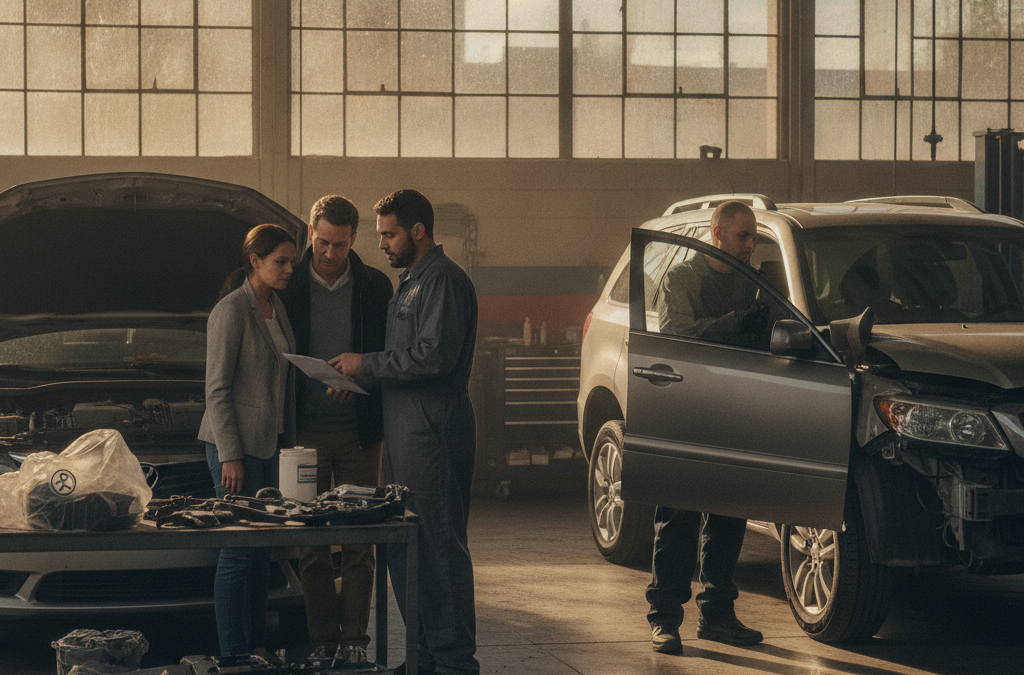
We’ve been serving the Bronx since 1975. In five decades, we’ve seen how the parts conversation has evolved — and how much it matters to drivers who want to know their car was put back together right. When you bring your vehicle to us, we give you a free, itemized estimate that breaks down exactly what parts are being used, where they’re coming from, and why. No surprises.
We work directly with Geico and other major insurers, and when OEM parts are the right call for your vehicle — especially on newer, certified, or EV models — we make that case to the insurance company on your behalf. Our job is to advocate for a repair that actually makes your car whole, not just one that closes the claim cheaply.
If you’re in Yonkers, White Plains, or coming in from Manhattan after an accident, the process is the same. We’re a family-owned shop, and we treat every vehicle like it belongs to someone we know — because in this community, it usually does.
Frequently Asked Questions
Can my insurance company force me to use aftermarket parts?
In New York, your insurer can specify aftermarket parts in an estimate, but they’re required to disclose this and guarantee fit and finish. If you have a newer vehicle or a manufacturer’s warranty, you may have grounds to request OEM parts. Talk to your shop — a certified shop can often negotiate this on your behalf.
Do aftermarket parts void my car’s warranty?
It depends on the manufacturer and the specific part. Some manufacturers take a strong stance on this — particularly for structural or safety-related components. If your vehicle is still under warranty, it’s worth asking your shop and your manufacturer before approving the repair.
Are all aftermarket parts bad?
Not necessarily. Some aftermarket parts — particularly for older vehicles or less critical components — are acceptable. But for newer vehicles, EVs, luxury cars, or any safety-related structural component, OEM parts are generally the right choice. The issue is that it’s not always obvious which category a given part falls into without expertise.
How do I know what parts were actually used in my repair?
Ask for an itemized repair order that lists every part installed, including part numbers. A reputable shop will provide this without hesitation. You can cross-reference part numbers with manufacturer databases if you want to verify OEM status.
Does S&T Auto Body use OEM parts?
Yes — especially for manufacturer-certified repairs and EV vehicles, where OEM parts are required under the certification agreement. For other vehicles, we discuss the options with you and advocate for OEM parts when it’s in your best interest. We’ll always be upfront with you about what’s going in your car.
Ready to Get a Straight Answer on Your Repair?
If you’ve been in a collision in the Bronx, Manhattan, or anywhere in the surrounding area and you want to know exactly what’s going into your repair — parts, process, and timeline — we’re here to walk you through it. No pressure, no runaround. Just an honest conversation and a free itemized estimate so you can make the right call for your vehicle.
Contact S&T Auto Body today to request your free estimate or to ask any questions before you commit to a repair. We’ve been doing this for 50 years, and we’re not going anywhere.