What Bronx and Throgs Neck Drivers Should Know About Getting a Car Repaired After a Deer Strike or Animal Collision
If you hit a deer — or any large animal — near Throgs Neck, Pelham Bay, or along any of the wooded corridors heading into Westchester County, the first thing to understand is this: the damage is almost always worse than it looks from the outside. A deer strike at highway speed can crumple body panels, crack radiator supports, damage cooling systems, break headlight assemblies, and in some cases push hard enough on the front end to affect the frame. Before you worry about anything else, get the car to a qualified shop that will actually look at all of it — not just what’s visible on the surface.
Is a Deer Strike Covered by Your Insurance — and Which Coverage Applies?
This is one of the most common points of confusion after an animal collision, and it’s worth clearing up right away. A deer strike is typically covered under comprehensive coverage, not collision coverage. That’s an important distinction because it affects your deductible and how the claim flows.
Comprehensive coverage is designed for damage caused by things outside your control — weather, falling objects, theft, and yes, animal strikes. If you only carry liability insurance (which is unfortunately common), you won’t have coverage for this type of damage at all. If you’re not sure what you carry, pull up your declarations page before you do anything else.
For drivers in the Bronx and surrounding areas who work with Geico — which is one of the larger insurers in this market — the claim process for a comprehensive event like a deer strike is generally straightforward. You report the incident, they assign an adjuster, and the car gets inspected. Choosing a shop that works directly with your insurer and can communicate on your behalf takes a significant amount of stress off your plate. At S&T Auto Body, we’ve been handling insurance claims for Bronx-area drivers for decades, and we know how to keep the process moving without you having to chase anyone down.
Why Deer Strikes Near Throgs Neck and the Bronx-Westchester Border Are More Common Than People Think
Most people think of deer collisions as a rural problem. But if you live or commute near Throgs Neck, Pelham Bay Park, or the northern edges of the Bronx — or if you regularly drive into Yonkers, Mount Vernon, New Rochelle, or deeper into Westchester County — you’re in territory where deer crossings are a real and documented hazard, especially at dawn and dusk in fall and early winter.
Pelham Bay Park alone is one of the largest urban parks in the United States, and it borders residential neighborhoods and commuter routes. Deer don’t respect city limits. Drivers heading from the Bronx into Westchester on local roads have reported strikes regularly, and the damage those animals can do to a modern vehicle — especially one with a lower front fascia or a crossover body style — is significant.
The point is: this isn’t a freak accident reserved for drivers in upstate New York. It happens to everyday commuters in this borough and along the county line, and knowing how to respond matters.
What the Damage Actually Looks Like — and What Gets Missed
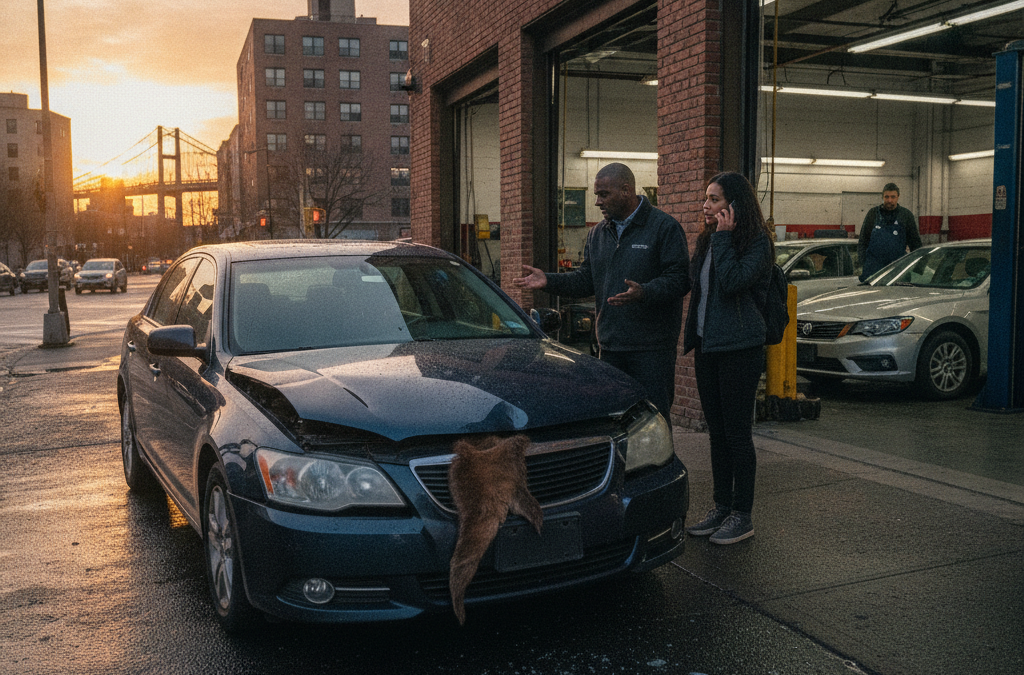
After a deer strike, you might see obvious damage: a smashed grille, dented hood, cracked headlight housing, broken front bumper cover. Those are the easy things to spot. What often gets missed — especially if a shop does a quick visual inspection and nothing more — includes:
- Radiator and cooling system damage — The radiator sits right behind the grille on most vehicles. A direct strike can puncture or bend it without it being immediately obvious.
- Hood latch and hinge damage — If the hood doesn’t close evenly or align the way it used to, something underneath took a hit.
- Headlight wiring and sensor damage — Modern headlight assemblies are integrated with cameras and proximity sensors on many vehicles. A cracked housing often means damaged electronics, not just a new lens.
- Subframe and front cradle stress — Depending on the speed and angle of impact, the force can transfer beyond the bumper into structural components.
- Airbag module triggers — On some vehicles, a frontal impact of sufficient force can arm or partially trigger airbag systems, which need to be inspected and reset even if no bags deployed.
A shop with I-CAR Gold Class certified technicians is trained to look for all of this — not just the cosmetic stuff. Our certifications at S&T Auto Body mean our team is held to industry-recognized standards for exactly this kind of thorough diagnostic work.
What to Do Immediately After Hitting a Deer or Animal
If it’s safe to do so, here’s what to do right after the collision:
- Pull over and turn on your hazard lights. Do not try to move an injured animal — that can be dangerous.
- Call 911 if anyone is injured or if the car isn’t drivable.
- Take photos of the damage from multiple angles before moving the vehicle if possible. You’ll need these for your insurance claim.
- Report the accident to local police — some counties and municipalities require this, and a police report strengthens your insurance claim.
- Call your insurer to open a comprehensive claim. You don’t need a police report to file, but it helps.
- Do not drive a vehicle with radiator damage, misaligned hood, or fluid leaks. Have it towed to a certified shop.
Once your car is at a trusted shop, ask for a written, itemized estimate before any work begins. At S&T Auto Body, we provide free itemized estimates so you know exactly what’s being repaired and why — no surprises when you come to pick up your car. You can request a free estimate here.
Does Your Car’s Make or Model Change How It Gets Repaired After an Animal Strike?
Yes, and this is an area that a lot of shops gloss over. If you’re driving a Mercedes-Benz, a Tesla, or another manufacturer-certified vehicle, the front-end components — bumper systems, sensor clusters, frame rails — are engineered to specific tolerances. Replacing them with generic aftermarket parts or skipping the manufacturer’s repair procedures can affect how the vehicle performs in a future collision, and in some cases can void your warranty.
For EV drivers in particular, a front-end collision raises additional concerns. High-voltage battery systems, frunk components (on Teslas), and integrated charging hardware can all be affected by the same impact force that damages your grille and hood. Our EV repair team is trained in high-voltage safety protocols and knows what to look for on vehicles like the Tesla Model 3, Model Y, and Model X after a frontal animal strike.
For any manufacturer-certified repair, we follow brand-specific procedures and use approved parts — which matters for your warranty and for the long-term integrity of the vehicle.
Frequently Asked Questions
Does hitting a deer count as an at-fault accident on my insurance record?
No. A deer strike is filed under comprehensive coverage, which is a non-fault claim in New York. It generally does not affect your at-fault accident rating, though it may factor into your overall claims history depending on your insurer. Confirm with your agent before filing if you have concerns.
Can I drive my car after hitting a deer?
It depends on the damage. If the airbags didn’t deploy, the car starts and drives normally, and nothing is visibly leaking, many people do drive home. But we’d strongly recommend having the vehicle inspected before putting significant miles on it. Hidden radiator damage can cause overheating, and misaligned front-end components affect handling and safety systems.
How long does a deer strike repair typically take?
It varies significantly based on the extent of damage and parts availability. A straightforward bumper, grille, and headlight repair might take a few days. If there’s structural damage, cooling system work, or sensor recalibration involved, plan for a week or more. We’ll give you a realistic timeline with your estimate — and we communicate throughout the process so you’re never in the dark.
Does my comprehensive deductible apply to a deer strike?
Yes. You’ll pay your comprehensive deductible, and your insurer covers the rest of the repair up to the vehicle’s actual cash value. If your deductible is higher than the repair cost, it may not make sense to file a claim — that’s a conversation worth having with your insurer before you decide.
What if I hit a smaller animal, like a raccoon or dog? Is that covered too?
Generally, yes — comprehensive coverage applies to collisions with any animal, not just deer. However, smaller animals rarely cause significant structural damage. If the damage is minor cosmetic, you may choose to pay out of pocket rather than file a claim, depending on your deductible.
We’ve Been Helping Bronx-Area Drivers Through Accidents Like This Since 1975
S&T Auto Body is a family-owned shop on 3rd Avenue in the Bronx. We’ve been in this community for over 50 years, and we’ve seen every kind of collision damage there is — including more deer strikes from drivers coming in from Throgs Neck, Pelham Bay, and the Westchester border than most shops in the city. We know how to handle the insurance side, the structural diagnosis, and the certified repair process — and we’ll walk you through every step plainly and honestly.
If your car was hit by a deer or any large animal and you need a thorough inspection and a free estimate, reach out to us directly. Don’t let hidden damage turn into a bigger problem down the road. Contact S&T Auto Body today and let us take a look — no obligation, no pressure, just honest answers from a shop that’s been here for the long haul.