What Bronx and Riverdale Drivers Should Know About Getting a Car Repaired After a Catalytic Converter Theft
If you walked out to your car this morning and it suddenly sounds like a motorcycle with a broken muffler — or worse, you can’t drive it at all — there’s a good chance your catalytic converter was stolen overnight. In the Bronx and nearby neighborhoods like Riverdale, Yonkers, and Mount Vernon, catalytic converter theft has become one of the most common vehicle crimes in the area. It happens fast, it’s loud and jarring to discover, and it leaves a lot of drivers standing there wondering what to do next. The short answer: don’t try to drive it, file a police report, then call your insurance company and a shop you trust. Here’s what the rest of that process looks like.
Why Catalytic Converter Theft Is So Common in the NYC Area
Catalytic converters contain precious metals — platinum, palladium, and rhodium — that are worth serious money on the black market. Thieves can saw one off in under two minutes with a battery-powered reciprocating saw, which is why it happens so often in densely parked areas, overnight, or in busy lots where a little noise doesn’t stand out. In a place like the Bronx, where street parking is the norm for most drivers, your vehicle is exposed every single night. The problem has hit Westchester County hard too, with reports coming from Yonkers and Mount Vernon at a steady pace.
Certain vehicles are targeted more than others. Trucks and SUVs with higher ground clearance are especially vulnerable because there’s more room to get under them. Hybrid vehicles like the Toyota Prius are also frequent targets because their converters contain a higher concentration of precious metals and wear more slowly — meaning the metals are in better condition for resale. But this can happen to almost any vehicle.
What Damage Are You Actually Looking At?
This is where a lot of drivers get surprised. They assume it’s just the converter itself — a part-and-labor replacement. But catalytic converter theft often causes damage that goes well beyond the converter. When thieves cut quickly and carelessly, they can damage:
- Oxygen sensors wired into the exhaust system — these are often clipped or destroyed in the process
- Exhaust pipes and flex pipes that get bent, cut, or torn during removal
- Heat shields and underbody components that get pried or punctured
- Wiring harnesses near the exhaust, depending on the vehicle
- Undercoating and underbody protection that gets scraped or damaged
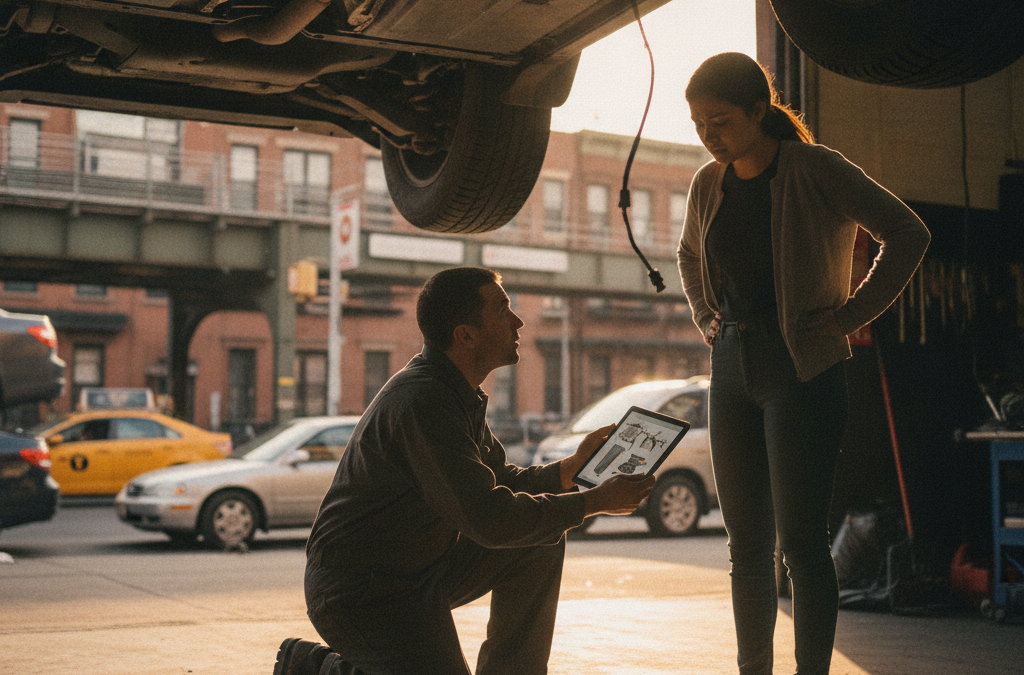
A proper repair means inspecting all of it — not just swapping in a new converter and calling it a day. This is the kind of thorough, itemized approach we take at S&T Auto Body, and it’s what you should expect from any reputable shop. If someone gives you a quote without putting the car on a lift and checking the full exhaust run and surrounding components, get a second opinion.
You can learn more about how we approach this kind of damage on our collision and mechanical repair page.
Does Your Insurance Cover Catalytic Converter Theft?
Here’s the question almost every driver asks, and the answer depends on what coverage you carry. Catalytic converter theft falls under comprehensive coverage — not collision. Comprehensive is the part of your auto policy that covers theft, vandalism, weather, and other non-collision events. If you only carry liability (which is the minimum required in New York), comprehensive theft coverage is not included.
If you do have comprehensive coverage, here’s how the claim process typically works:
- File a police report first — your insurance company will require a report number
- Call your insurer to open a claim (Geico and other major carriers have 24-hour claim lines)
- Get a written estimate from a reputable shop — not just a phone quote
- Your deductible will apply, so factor that into your decision about whether to use insurance or pay out of pocket
- The insurer will either approve repairs directly or send an adjuster to inspect the vehicle
One thing worth knowing: if the theft also caused damage to surrounding components — oxygen sensors, exhaust pipes, wiring — a good shop will document all of it in the estimate so your claim reflects the full scope of repairs. Don’t let anyone talk you into a minimal repair that leaves your car running rough or throwing check engine lights weeks later.
What to Look for in a Shop Handling This Kind of Repair
Not every body shop handles exhaust system and underbody repairs — some are purely cosmetic. And not every mechanic is equipped to deal with the full scope of what theft damage can involve, especially on newer vehicles with more complex sensor systems. Here’s what to ask:
- Do they perform a full underbody inspection, not just a visual check of the cut?
- Are they using OEM or quality replacement parts, not the cheapest aftermarket converter available?
- Can they provide a written, itemized estimate you can submit to your insurance company?
- Do they have certified technicians — I-CAR Gold Class or better — who understand both mechanical and structural repairs?
At S&T Auto Body, our I-CAR Gold Class certified technicians are trained across both mechanical and structural repair disciplines. We’ve been serving drivers in the Bronx since 1975, and we know this kind of damage well. We provide free, itemized written estimates so you have something concrete to work with, whether you’re going through insurance or paying out of pocket.
Should You Replace with OEM or Aftermarket?
This is a real question and it’s worth understanding. OEM (original equipment manufacturer) catalytic converters are made to your vehicle’s exact specifications and are required by some manufacturers to maintain emissions compliance and warranty protections. Aftermarket converters vary widely in quality — some are fine, some are not — and in New York State, your replacement converter must meet state emissions standards or your car will fail inspection.
If you drive a newer vehicle, a hybrid, or a manufacturer-certified vehicle, ask specifically about OEM replacement. For older vehicles, a quality aftermarket option may be perfectly appropriate and more cost-effective. A trustworthy shop will walk you through the tradeoffs honestly rather than just defaulting to whatever’s cheapest to source.
Frequently Asked Questions
Can I drive my car after the catalytic converter is stolen?
You shouldn’t. Driving without a catalytic converter can damage your engine over time, and it’s also illegal in New York because the vehicle will fail emissions standards. It’s also very loud, which can get you pulled over. Have the vehicle towed to a shop.
How long does the repair take?
A straightforward converter replacement with minimal additional damage can often be completed in one to two days. If there’s extensive exhaust pipe damage, sensor replacement, or parts need to be ordered, plan for two to four days. Availability of your specific part will be the biggest variable.
Do I need to file a police report even if I have insurance?
Yes — virtually every insurance company requires a police report number to process a comprehensive theft claim. File the report with your local NYPD precinct or, if the vehicle is registered in Westchester, with the appropriate local department. Do this before you call your insurer.
Will a catalytic converter theft claim raise my insurance rates?
Comprehensive claims are generally treated differently from collision claims, and many insurers do not raise rates for a single theft claim. That said, it varies by insurer and your history. It’s worth calling your agent to ask before you decide whether to file or pay out of pocket — especially if your deductible is high relative to the repair cost.
Is there anything I can do to prevent this from happening again?
Catalytic converter protection plates (also called cat shields) are available for many popular vehicle models and can be installed by a qualified shop. Parking in well-lit, high-traffic areas and using an alarm with a tilt sensor can also help deter theft. Ask us about protection options when you bring your vehicle in for repair.
Get a Free Estimate From a Shop That Knows What to Look For
If your catalytic converter was stolen — in Riverdale, anywhere else in the Bronx, or a nearby area like Yonkers or Mount Vernon — we’re ready to help you figure out exactly what you’re dealing with and get you back on the road. We’ll put the car on a lift, inspect the full exhaust system and surrounding components, and give you a written itemized estimate you can actually use. No guessing, no surprises.
S&T Auto Body has been a family-owned shop on 3rd Avenue in the Bronx since 1975. We work with all major insurers including Geico, and we’ll walk you through the claims process if you need a hand. Contact us today to request your free estimate — by phone, online, or just stop in.