What Bronx and Garden City Drivers Should Know About Getting a Tesla Repaired After a Collision
If you drive a Tesla and you’ve just been in a collision — whether it happened near the Cross Bronx Expressway or on the way home from Garden City — the most important thing to understand right now is this: your Tesla cannot go to just any body shop. It’s not a matter of preference. It’s a matter of safety, warranty protection, and whether the repairs are actually done right. A standard body shop, no matter how experienced with conventional vehicles, simply does not have the training, equipment, or manufacturer authorization to properly repair a Tesla after a crash.
At S&T Auto Body, we’ve been repairing vehicles in the Bronx since 1975. We’ve watched the auto industry change a lot over five decades — and the rise of electric vehicles, Tesla in particular, is one of the most significant shifts we’ve ever seen. We take that seriously. Here’s what you need to know before your Tesla gets towed anywhere.
Why Tesla Repair Is Fundamentally Different from Conventional Collision Repair
Tesla vehicles aren’t built like traditional cars. The Model 3, Model Y, Model S, and Model X all use large-format aluminum body panels and structural components — not the steel construction most body shops are equipped to work with. Aluminum behaves differently under impact and requires entirely different repair and welding techniques. Use the wrong process on an aluminum panel and you can compromise the structural integrity of the entire vehicle without it being immediately obvious.
Beyond the body structure, there’s the battery pack. Tesla’s battery system runs at high voltage — we’re talking 400 volts or more. In a collision, that system needs to be properly assessed and handled before any repair work begins. This isn’t something a general shop can safely improvise. Technicians need specific high-voltage safety training to work around EV battery systems without creating a dangerous situation for themselves or for you as the owner.
Then there’s the software. Tesla’s vehicles rely on a sophisticated network of sensors, cameras, and driver assistance systems — Autopilot components, radar, ultrasonic sensors — many of which are embedded in bumpers, mirrors, and body panels that get damaged in collisions. Restoring those systems to factory spec after a crash requires calibration equipment and access to Tesla’s repair procedures. A shop without that access will replace your bumper cover, hand you back your car, and you may drive home not knowing your Autopilot camera is misaligned.
What a Tesla-Certified or Tesla-Approved Repair Actually Involves
Tesla maintains a network of approved collision repair centers — shops that have met Tesla’s standards for tooling, training, and repair procedures. When your Tesla is repaired at a shop with the right credentials and equipment, the work is done according to Tesla’s official repair methods using genuine Tesla parts. That matters because Tesla tracks repair history, and non-OEM parts or unauthorized repairs can affect your vehicle’s warranty and even its resale value.
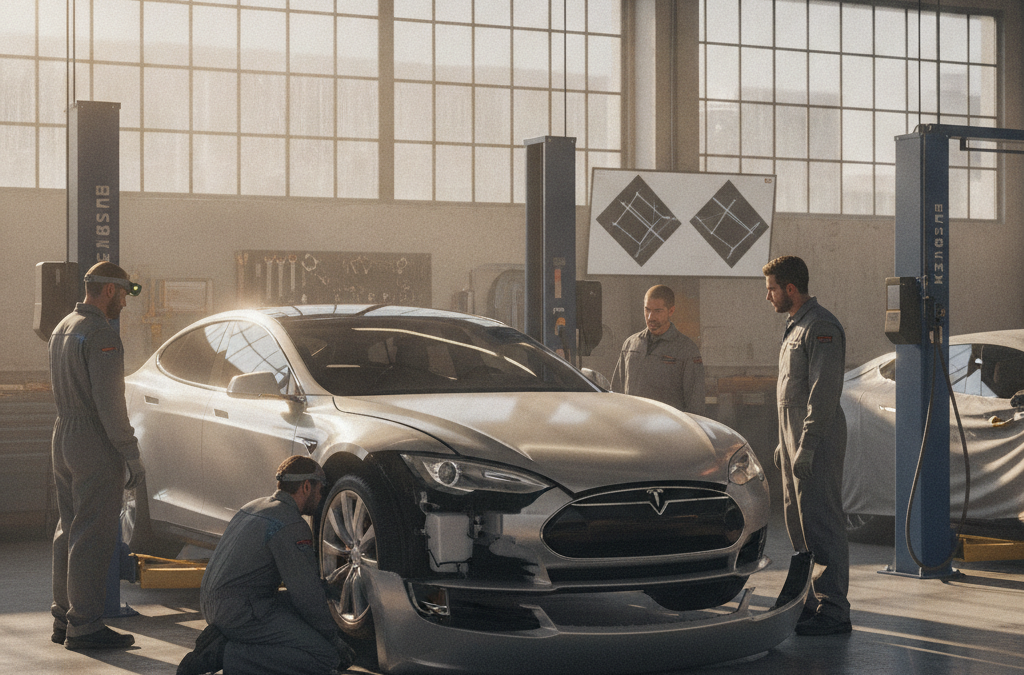
At a properly equipped shop, a Tesla repair typically involves:
- A full structural inspection using manufacturer-specified measuring systems
- High-voltage system assessment before any disassembly begins
- Aluminum body repair using approved techniques — riveting, bonding, and in some cases panel replacement rather than conventional welding
- OEM Tesla parts, not aftermarket alternatives
- Sensor and camera recalibration after any panel or bumper work
- A final quality check that includes both physical and electronic system verification
This is a different level of process than what most shops run, and it’s why choosing the right shop matters so much. Learn more about our EV and Tesla body repair services at S&T Auto Body.
The Gap Most Local Shops Aren’t Filling — and Why It Matters in the Bronx
Here’s something worth noting: if you look at most local collision shops in the Bronx and surrounding areas, you’ll find very little concrete information about what their Tesla repair process actually involves. Some mention EVs in passing. Others list Tesla on their website without explaining how they handle high-voltage systems or aluminum body repair. That lack of specificity should give you pause.
The Bronx and surrounding areas — including Queens, Riverdale, and communities across Westchester County and Nassau County — have seen Tesla ownership grow significantly over the past several years. That means there are more Tesla drivers than ever who will eventually need collision repair, and who deserve to know exactly what qualifications their shop has before they hand over the keys.
The question to ask any shop directly: Are your technicians specifically trained in Tesla or EV high-voltage safety, and do you use Tesla’s documented repair procedures? If they can’t answer that clearly, keep looking.
What About Your Insurance Claim After a Tesla Collision?
Tesla repairs can run higher than conventional vehicle repairs — partly because of OEM parts costs, partly because of the labor involved in aluminum work and sensor recalibration. That can create friction with insurers who are looking to minimize payout.
A few things to know going in:
- You have the right to choose your own repair shop in New York State, regardless of which insurer you’re working with or where they want to send you.
- Insist on OEM Tesla parts in your repair authorization. Aftermarket parts exist for some Tesla components, but they don’t meet the same specifications and can create safety and warranty problems.
- Get a full itemized estimate before any work begins, and make sure it accounts for the diagnostic and recalibration work — not just visible body damage.
- If you’re working with Geico or another major insurer, our team can work directly with your adjuster to make sure the claim reflects what your Tesla actually needs.
We’ve been navigating insurance claims for Bronx and NYC-area drivers for a long time. We know how to advocate for a complete, accurate repair — not a cost-cut version of one.
Choosing the Right Shop: Questions to Ask Before You Commit
Whether you’re in the Bronx, coming in from Garden City, or anywhere across the metro area, here’s what to ask a shop before you authorize repairs on your Tesla:
- Do your technicians have EV-specific training, including high-voltage safety certification?
- Do you use Tesla OEM parts, or aftermarket alternatives?
- How do you handle sensor and camera recalibration after body work?
- Are you I-CAR Gold Class certified? (This is a baseline indicator of ongoing technical training across the shop.)
- Can you provide a full itemized written estimate before work begins?
At S&T Auto Body, our technicians hold I-CAR Gold Class certification — which means continuous, up-to-date training in the latest repair technologies, including EV-specific procedures. We don’t treat a Tesla like it’s just another car, because it isn’t. See our full list of certifications here.
Frequently Asked Questions
Can any body shop in the Bronx repair a Tesla?
Technically, any shop can attempt it — but that doesn’t mean they should. Tesla vehicles require specialized training in high-voltage systems, aluminum body repair, and sensor recalibration. Repairs done outside of Tesla’s specified procedures can create safety problems and void your warranty. Always ask a shop about their specific EV qualifications before authorizing work.
Will getting my Tesla repaired at a non-dealer shop void my warranty?
Not necessarily — but it depends on the shop’s qualifications and the parts used. In New York State, you have the right to use an independent shop. However, repairs done with non-OEM parts or outside of Tesla’s repair standards can create warranty complications. Choose a shop that uses genuine Tesla parts and follows Tesla’s documented repair procedures.
How long does it take to repair a Tesla after a collision?
It varies widely depending on the extent of damage. Minor collision repairs might take a week or two. More significant structural or battery-adjacent damage can take longer, especially if parts need to be ordered. Tesla parts lead times have improved, but they can still be longer than what you’d expect for conventional vehicles. Your shop should give you a timeline estimate upfront and keep you updated.
Does insurance cover Tesla-specific repair costs like sensor recalibration?
It should, yes — but you may need to advocate for it. Make sure your repair estimate includes all necessary diagnostic and calibration work, not just visible body repair line items. A good shop will document everything and communicate directly with your insurer to make sure the full scope of repairs is covered.
I live in Garden City or Nassau County — is it worth coming to the Bronx for Tesla repair?
If your local options don’t have the specific certifications and EV training you need, then yes, the drive is worth it. Drivers come to us from across the metro area — from Westchester County, Queens, Manhattan, and Nassau County — because they want to know the work is being done right the first time. A Tesla is a significant investment. It deserves a shop that treats it like one.
Ready to Get Your Tesla Repaired the Right Way?
If your Tesla has been in a collision — or if you just want to know what your options are before something happens — we’re here to talk it through. S&T Auto Body has been a family-owned shop in the Bronx for 50 years. We’re not a chain, and we’re not going to rush you through a process you don’t understand. We’ll give you a free, itemized estimate, walk you through your options, and work directly with your insurance company so you’re not stuck in the middle.
Contact us today to schedule your free estimate or ask us anything about Tesla and EV collision repair. We’re here when you need us.