
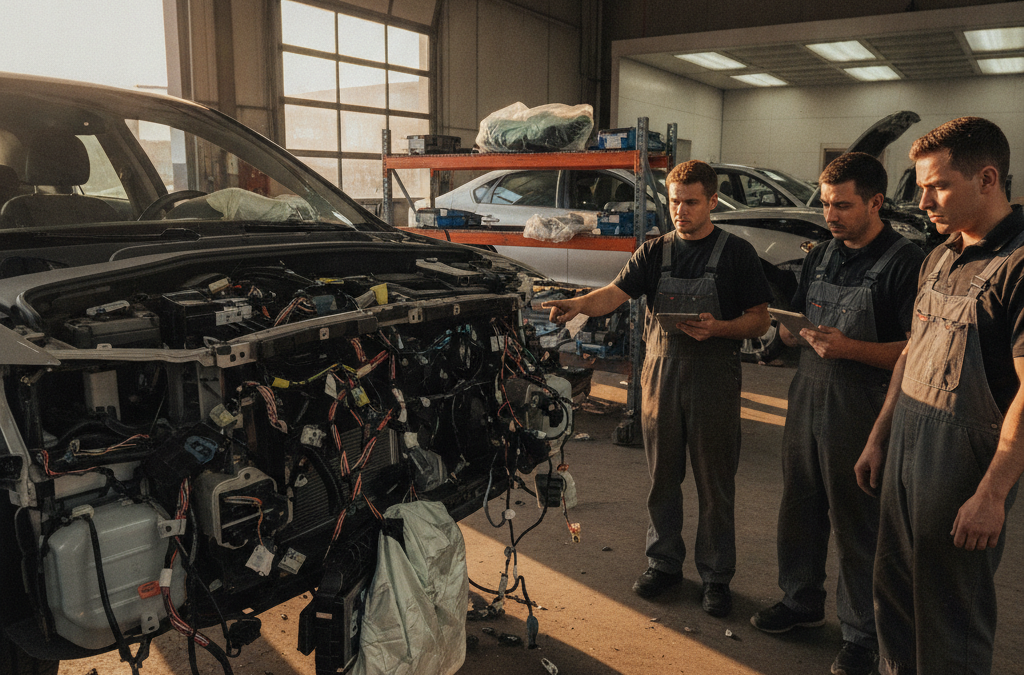
What Bronx and Yonkers Drivers Should Know About Getting a Car Repaired When the Airbags Have Deployed
If your airbags went off during a collision, your car needs more than a cosmetic fix — it needs a thorough, certified repair from a shop that understands how safety systems actually work. Deployed airbags are one of the most misunderstood areas of collision repair, and unfortunately, one of the most commonly mishandled ones too. Whether you were in a fender-bender on the Cross Bronx Expressway that turned serious, or you took a hard hit on a Yonkers street, here’s what you genuinely need to know before you pick a body shop.
It’s Not Just the Airbag — It’s the Whole System
Most people assume that airbag repair means swapping out the deployed bag and moving on. That’s not how it works. Your vehicle’s airbag system — called the Supplemental Restraint System, or SRS — is a network of sensors, control modules, wiring harnesses, seat belt pretensioners, and clock springs, all working together. When airbags deploy, many of those components are damaged or triggered in ways that aren’t visible to the naked eye.
A shop that just replaces the bag and clears the warning light hasn’t actually fixed your car — they’ve hidden the problem. If those underlying components aren’t inspected and replaced where needed, your airbags may not work correctly the next time you need them. That’s not a risk worth taking.
At S&T Auto Body, our I-CAR Gold Class certified technicians are trained specifically on SRS system diagnosis and repair. That certification isn’t just a plaque on the wall — it means our team completes ongoing training on exactly these kinds of safety-critical repairs.
What a Proper Airbag Repair Actually Involves
Here’s what a thorough, safety-compliant airbag repair should include:
- SRS module inspection and replacement: The airbag control module often needs to be replaced after deployment. Some can be reset by a qualified technician, but only after careful evaluation. Many shops skip this step entirely.
- Seat belt pretensioner inspection: When airbags go off, the seat belt pretensioners fire at the same time to lock you in place. Those pretensioners are typically single-use components and need to be replaced.
- Sensor replacement and recalibration: Impact sensors throughout the vehicle detect crash forces and trigger the airbag system. These need to be checked and recalibrated — especially in vehicles with advanced driver-assistance systems (ADAS).
- Steering column and clock spring inspection: The clock spring, which keeps electrical connections active as your steering wheel turns, is often damaged when the driver’s airbag deploys.
- Complete wiring harness check: Deployment events can damage wiring in ways that don’t show up immediately but cause electrical gremlins down the road.
- Post-repair SRS system scan: After all components are addressed, the system should be scanned with professional diagnostic equipment to verify everything reads correctly before the car goes back on the road.
Why This Matters Even More in NYC-Area Traffic
Dense urban traffic in the Bronx, Yonkers, and Manhattan means more close-quarters collisions — the kind where airbags deploy at speeds that might not look catastrophic from the outside but are serious enough to trigger your SRS system. In New York City metro conditions, where stop-and-go traffic and tight intersections are daily reality, these types of mid-speed impacts happen constantly.
The problem is that a car that looks drivable after a deployed-airbag collision may have hidden structural damage, a compromised SRS system, or both. Driving it without a proper inspection — or having it repaired by a shop that isn’t equipped to handle SRS systems — puts you right back in danger the next time something goes wrong.
Drivers coming to us from Westchester County and Mount Vernon often mention that they weren’t warned about this at all after their accidents. That’s a gap we take seriously.
What Most Competitor Shops Don’t Tell You About Airbag Repair
After reviewing the content on several local competitor websites, one thing stands out clearly: almost none of them explain what airbag deployment actually means for the full scope of your repair. You might find a mention of airbag replacement listed as a service, but the deeper explanation — the SRS module, the pretensioners, the sensors, the recalibration — is almost entirely absent. That’s a real disservice to drivers who need to understand what they’re agreeing to when they hand over their car.
A shop that lists “airbag replacement” without explaining everything connected to it may not be doing the full job. Ask directly: Are you inspecting and replacing the SRS control module? What about the seat belt pretensioners? Will you run a full diagnostic scan after the repair? If a shop can’t answer those questions clearly, that’s a warning sign.
How Insurance Handles Airbag Deployment Claims
Here’s the reassuring part: if your airbags deployed, your insurance company generally treats this as a significant collision claim, and airbag system repair — done correctly — is typically covered. This includes the SRS module, pretensioners, sensors, and related components. If you’re insured through Geico, we’re a preferred shop, which means the claims process is more streamlined and there’s less back-and-forth between you and the insurer.
What you want to avoid is a shop that cuts corners to bring the estimate down and make the insurer happy in the short term. Proper SRS repair costs what it costs — and any shop lowballing an airbag job is almost certainly leaving something out. We provide free, itemized estimates so you can see exactly what’s being repaired and why, with no surprises.
Learn more about our collision and mechanical repair services and how we handle the full scope of post-collision work, including safety system restoration.
Does Your Car’s Make Matter for Airbag Repair?
Yes — and this is another area where manufacturer certification matters more than most drivers realize. Different automakers use different SRS architectures, and repairing a Mercedes-Benz airbag system correctly is not the same process as repairing one on a Hyundai or a Ford. Manufacturer-certified shops have access to brand-specific repair procedures, the correct OEM or OEM-equivalent parts, and diagnostic tools calibrated for that vehicle’s systems.
For EV drivers — especially Tesla owners in the Bronx and surrounding boroughs — airbag repair adds another layer of complexity. High-voltage systems in EVs require technicians trained in both electrical safety and SRS repair. These aren’t skills every shop has, and handling them incorrectly isn’t just a quality issue — it’s a safety issue.
Frequently Asked Questions
Can I drive my car after the airbags have deployed?
In most cases, no — or at least not until it’s been inspected. Even if the car starts and seems to drive, the SRS system is compromised and other structural or mechanical damage may be present. Have it towed to a certified shop for a full evaluation first.
Will my car be totaled if the airbags deployed?
Not necessarily. It depends on the overall extent of damage relative to the car’s value. Airbag system repair is expensive, but many vehicles — especially newer or higher-value cars — are well worth repairing properly. Your insurer makes the total-loss determination based on repair cost vs. actual cash value.
How long does airbag system repair take?
It varies significantly depending on the vehicle and how many components need replacement. A straightforward repair on a common vehicle might take several days; a more complex job on a European or luxury vehicle with multiple airbag zones can take longer. We’ll give you a clear timeline upfront with your estimate.
Can a shop just reset the airbag light without replacing anything?
Some shops do this — it’s called “clearing codes” — and it’s a serious red flag. Clearing the warning light without actually replacing the deployed components means your SRS system is not functional. This is dangerous and, in New York, could also create liability issues if the vehicle is later involved in another accident.
Does airbag repair affect my car’s resale value?
A properly documented, certified airbag repair from a reputable shop has far less impact on resale value than an undisclosed or poorly done repair. When the work is done right and the records show it, buyers and dealers can see that the car was restored to proper safety standards. Cutting corners on this kind of repair is what really tanks a vehicle’s value — and its safety.
Get Your Car Repaired Right — The First Time
At S&T Auto Body, we’ve been handling serious collision repairs in the Bronx for over 50 years. We’re a family-owned shop, not a chain — and when you bring your car to us after an airbag deployment, we treat it with the same care we’d want for our own families. That means doing the full job: every component inspected, every safety system restored, and a complete post-repair scan before your car leaves our lot.
If your airbags have deployed — or if you’re not sure whether your car is safe to drive after a recent collision — contact us for a free, no-obligation estimate. We’ll walk you through exactly what needs to be done, work directly with your insurance company, and get you back on the road with confidence. Call us at (718) 220-2201 or stop by — we’re here to help.