What Should Bronx and Long Island City Drivers Know About Repairing a Car With Airbag or Sensor Damage After a Collision?
If your airbags went off during an accident — or if your car’s collision warning lights came on and never went away — you’re dealing with more than bent sheet metal. Airbag and sensor damage is one of the most misunderstood parts of collision repair, and it’s also one of the most important to get right. A shop that fixes your bumper but ignores a miscalibrated backup sensor or a deployed side curtain airbag isn’t just doing an incomplete job — they’re sending you back out onto the road with a car that may not protect you the next time something goes wrong. Here’s what every driver in the Bronx and surrounding areas, from Long Island City to Yonkers to White Plains, should understand before they hand over their keys.
Airbag Deployment Isn’t Just a Parts Swap
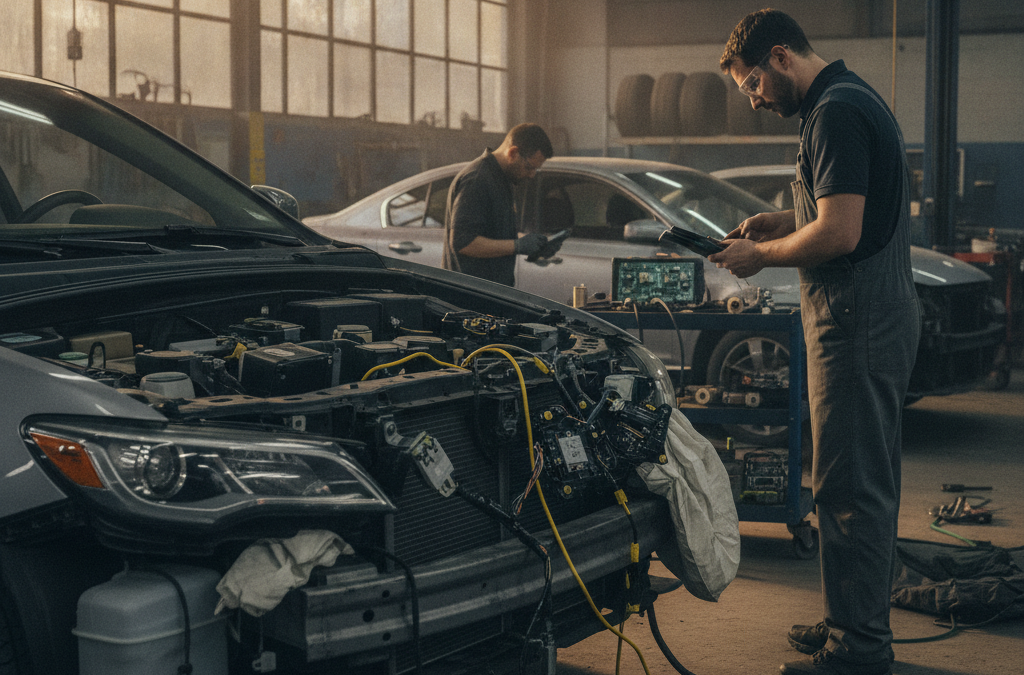
A lot of drivers assume that replacing a deployed airbag is like replacing a headlight. You pull the old one, put in the new one, and you’re done. It’s not that simple. When an airbag deploys, the entire supplemental restraint system — the SRS — is affected. That includes the airbag module itself, the clock spring in the steering wheel, the seat belt pretensioners, and the crash sensors that triggered the deployment in the first place. In many vehicles, the SRS control module has to be replaced or reprogrammed as well, because it stores the deployment event and won’t allow the system to reset without the right equipment and credentials.
If a shop replaces your airbag but doesn’t address the control module or recalibrate the system, your SRS warning light will stay on — which means your airbag may not deploy correctly in a future collision. That’s not a warning you can ignore. In New York, a vehicle with an SRS fault will fail inspection, which means your car could be off the road until it’s fixed properly anyway.
What ADAS Sensors Have to Do With Body Repair
Newer vehicles — and this covers a huge portion of what’s being driven around the Cross Bronx Expressway and through the streets of Manhattan, Long Island City, and Westchester County right now — are packed with advanced driver assistance systems, commonly called ADAS. These include:
- Forward collision warning and automatic emergency braking
- Lane departure warning
- Blind spot monitoring
- Rear cross-traffic alert
- Adaptive cruise control
- Parking assist cameras and sensors
Here’s the problem: almost all of these systems rely on sensors, cameras, and radar modules that are mounted in, on, or very close to the parts of your car that get damaged in a collision. Your front radar sensor might be tucked behind the grille. Your forward-facing camera might be at the top of the windshield. Blind spot radar units are often inside the rear bumper cover.
When those panels and bumpers are repaired or replaced — even correctly — the sensors need to be recalibrated to manufacturer specifications. This isn’t optional, and it isn’t something every shop knows how to do. Recalibration requires specialized equipment and, in many cases, a controlled environment or a specific road test procedure. A shop without that equipment can fix the cosmetic damage and hand you back a car where your automatic braking system is aimed six inches off — which is exactly when you don’t want to find that out.
Why This Is a Gap Most Local Shops Don’t Talk About
Most auto body shop websites — including a number of shops competing for your business in the Bronx and across the metro — focus their content on paint, dent repair, and frame straightening. That’s understandable; those are the things drivers see and understand. But airbag system restoration and ADAS recalibration almost never come up, even though they’re standard parts of a complete collision repair on any vehicle made in the last several years.
This isn’t a small omission. It means drivers are showing up at shops without asking the right questions, and some shops are completing repairs without addressing systems that directly affect crash safety. At S&T Auto Body, our I-CAR Gold Class certified technicians are trained specifically on these systems — because I-CAR certification requires ongoing education that covers exactly this kind of evolving vehicle technology. That training matters every time a newer vehicle comes through our doors.
What to Ask Any Shop Before You Commit
Whether you’re getting your car repaired after a fender bender on Fordham Road or a more serious collision on the highway, here are the questions worth asking before you drop off your vehicle:
- Do you inspect and reset the SRS system after airbag deployment? If they say yes, ask specifically whether they replace or reprogram the SRS control module when required.
- Do you perform ADAS recalibration after bumper, windshield, or panel repairs? Some shops outsource this — which can be fine, but you deserve to know.
- Are your technicians trained on the specific make and model of my vehicle? Manufacturer certification programs exist precisely because each brand’s systems work differently.
- Will the repair restore my vehicle to pre-accident safety specifications? This is the bottom line. A shop confident in its work should have no hesitation answering this directly.
If a shop seems confused by these questions, or gives you a vague answer, that’s useful information. You’re not being difficult — you’re protecting yourself.
Insurance Coverage and Airbag Repair in New York
The good news is that airbag replacement and sensor recalibration are generally covered under comprehensive or collision coverage if the damage resulted from an accident. Your insurer — whether that’s Geico, State Farm, or another carrier — will typically include these costs in the repair estimate as long as the shop documents them properly.
The catch is that you need a shop that knows how to write up the claim correctly. An itemized estimate that clearly specifies SRS module replacement, sensor recalibration, and labor time for each step gives your insurance adjuster exactly what they need to approve the work. A vague estimate that just says “airbag repair” can lead to delays, supplemental claims, and back-and-forth that keeps your car in the shop longer than necessary. We help drivers navigate this process every day — our collision repair process includes working directly with your insurer so you’re not stuck in the middle.
EVs and Luxury Vehicles Add Another Layer
If you’re driving a Tesla, a Mercedes-Benz, or another high-end or electric vehicle, airbag and sensor repair gets even more specific. Tesla’s restraint systems and camera-based ADAS (they call it Autopilot and Full Self-Driving) require calibration procedures that can only be done through Tesla-approved software and tooling. Mercedes-Benz has its own diagnostic and recalibration standards that differ from what a generic scan tool can access.
Drivers in White Plains, Manhattan, and across Westchester County who own these vehicles have good reason to be selective about where they take their car. Getting the body work done at a shop that doesn’t have the right certifications or equipment for your make means you may end up needing a second trip — to a dealer or a certified shop — just to get the safety systems properly addressed. That’s double the hassle and potentially more cost. S&T Auto Body holds manufacturer certifications covering a wide range of makes, which means your car’s safety technology gets addressed alongside the body repair, not as an afterthought.
Frequently Asked Questions
Will my car pass NYS inspection if the airbag light is on after a collision?
No. A lit SRS warning light will cause your vehicle to fail New York State inspection. The airbag system must be properly repaired and the fault cleared before the car can be certified as roadworthy.
Does my insurance cover airbag replacement and sensor recalibration?
In most cases, yes — if the damage occurred during a covered accident. Your collision or comprehensive coverage should include these costs when documented properly in the repair estimate. Always confirm your coverage details with your insurer.
How long does airbag and sensor repair take?
It varies depending on the vehicle and the extent of the damage. A single airbag replacement with SRS reset might add a day or two to an otherwise straightforward repair. Vehicles with multiple airbag deployments or extensive ADAS recalibration needs will take longer. We’ll give you a clear timeline as part of your estimate.
Can any body shop handle airbag and ADAS repairs, or do I need a specialist?
Not every shop is equipped for it. You want a shop with I-CAR trained technicians and, ideally, manufacturer certifications for your specific vehicle. Ask directly before you commit.
My airbag didn’t deploy, but my warning light came on after the accident. Does that still need attention?
Yes. A triggered sensor or fault code in the SRS module means the system detected an event. Even if airbags didn’t deploy, the system may be compromised and should be inspected and cleared by a qualified technician before you drive the car normally.
Get a Free Estimate From a Shop That Covers the Whole Repair
At S&T Auto Body, we’ve been doing this work in the Bronx since 1975. We’ve watched vehicles go from simple mechanical systems to rolling computers — and we’ve kept pace with every step of that evolution. Our I-CAR Gold Class certified technicians don’t just fix what you can see. They make sure the systems underneath and behind the panels are working the way the manufacturer intended, so you can drive with confidence.
If your airbag deployed, your sensor lights are on, or you just want a straight answer about what your car actually needs after a collision, we’re here to help. Contact us or request a free estimate — no pressure, no runaround, just an honest assessment from a shop that’s been earning trust in this neighborhood for five decades.