What Bronx and Nassau County Drivers Should Know About Getting Paint Work Done Right After a Collision
After a collision, getting the paint right is one of the most important — and most underestimated — parts of the repair. Whether you drive in the Bronx, commute from Garden City, or live anywhere in Nassau County, a poorly matched paint job is something you’ll notice every single time you walk up to your car. And so will buyers if you ever go to sell it. The good news is that when it’s done correctly by technicians who actually know what they’re doing, a repaired panel should be virtually indistinguishable from the original. Here’s what you need to know before you approve any paint work.
Why Paint Matching Is Harder Than It Looks
Every car that comes off the factory floor has a unique paint code — a specific formula of color and metallic content created for that make, model, and sometimes even that production year. But the paint on your car doesn’t stay factory-fresh. Sun exposure, washing, road grime, and age all cause gradual fading. That means a shop can’t just look up your paint code, mix the formula, and call it a day. If they do, the new paint will almost certainly look different from the panels around it — slightly brighter, slightly richer, or a shade off.
This is called a color mismatch, and it’s one of the most common complaints drivers have after getting collision work done at shops that cut corners. You might not notice it right away in the shop’s fluorescent lighting, but step outside on a sunny day and it becomes obvious fast.
What separates a shop that gets it right from one that doesn’t? A few things: the quality of the paint mixing equipment they use, whether they take the time to do a test panel before spraying, how they blend the new paint into adjacent panels, and the skill of the person actually holding the spray gun. This is not a job for someone learning on the fly.
What Good Paint Work Actually Involves
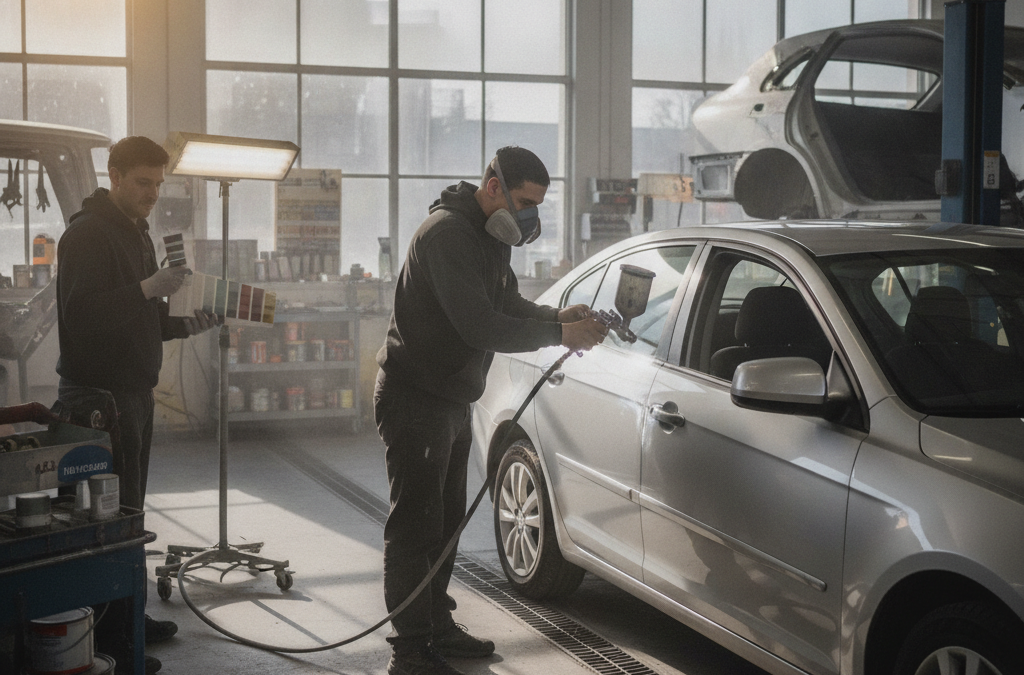
When S&T Auto Body handles a paint repair, we’re not just slapping color on a panel and sending you home. Here’s what a proper collision paint job looks like from start to finish:
- Surface preparation: The damaged area has to be completely clean and properly primed before any color goes on. Any rust, contamination, or body filler that isn’t perfectly smooth will show through the finished paint.
- Color reading and custom mixing: We use computerized paint mixing systems that read the actual color on your vehicle — not just the factory code — and adjust the formula to account for how your car’s paint has aged.
- Test panels: Before we spray the car, we spray a test card in the same environment to verify the color match under different lighting conditions.
- Blending into adjacent panels: Even with a perfect color match, the repaired panel gets blended into the panels next to it so there’s no visible seam or edge where the new paint begins.
- Clear coat application: The color coat alone won’t protect your car. A proper clear coat layer — applied evenly and cured correctly — is what gives the paint its gloss and protects it from UV damage, moisture, and road debris.
- Buffing and finishing: Once everything is cured, the surface is wet-sanded and buffed to bring out the gloss and eliminate any texture inconsistencies.
Skip any one of those steps, and the result shows. This is where a lot of the cheaper shops — the ones promising a three-day turnaround for a fraction of the price — tend to cut corners.
What Competitors in This Area Often Don’t Tell You About Paint
Here’s something worth knowing: most of the collision repair content you’ll find online from local shops focuses on the structural side of the repair — frame straightening, panel replacement, alignment. Paint gets treated as an afterthought, almost like it’s automatically included and automatically fine. It’s rarely explained in any detail.
That’s a gap, because paint is often what you’ll actually live with. The frame straightening is done behind the scenes. The paint is what you see every morning. Drivers deserve a straight answer on what goes into it, what can go wrong, and how to make sure they’re getting quality work.
If you’re picking up your vehicle and something about the color looks off — especially in natural daylight — don’t just accept it. A reputable shop will address it. If they push back, that’s information you need.
Clear Coat Failure: A Problem That Shows Up Months Later
One issue that doesn’t get nearly enough attention is clear coat failure after a repair. This happens when the clear coat was applied too thin, wasn’t properly cured, or was applied over a surface that wasn’t fully prepped. You might not see it right away. But within six to eighteen months, you start to notice the paint looking dull, developing small cracks, or beginning to peel at the edges of the repaired area.
This is particularly common with lower-cost repairs that rush the curing process or skip proper baking in a spray booth. A shop with a heated paint booth — where temperature and airflow are controlled — produces a significantly more durable result than one that’s painting in an open bay or using cold-cure shortcuts.
At S&T Auto Body, our I-CAR Gold Class certified technicians follow manufacturer-approved repair and refinishing procedures. That means your clear coat is applied and cured the right way, so the finish holds up over time — not just long enough to get through the warranty period. You can learn more about what our certifications mean for repair quality on our certifications page.
Does Your Insurance Cover Quality Paint Work — or Just Adequate Paint Work?
This is a question a lot of drivers in the Bronx and across Nassau County never think to ask, and it matters. Insurance companies are in the business of paying what they’re required to pay — which is to restore your vehicle to its pre-accident condition. That should include a proper paint match and finish. But some shops that work closely with certain insurers prioritize speed and low cost over quality, because that’s what the insurer is pushing for.
You have the right to a proper repair. If a shop or insurer is pressuring you toward a faster or cheaper paint process, ask specifically: What mixing system are you using? Will adjacent panels be blended? Do you have an enclosed paint booth? Will the clear coat be baked? These are reasonable questions, and a good shop will answer them without hesitation.
As a Geico preferred shop, we work directly with your insurer to make sure the repair is authorized correctly — including the paint — so you don’t end up fighting over supplemental claims after the fact. You can see the full scope of our collision repair services if you want to understand what goes into a complete estimate.
Special Considerations for Luxury and EV Paint Finishes
If you drive a Mercedes-Benz, Tesla, or another luxury or electric vehicle, paint work gets even more involved. Many of these vehicles use multi-stage paint systems — base coat, effect coat, and clear coat — that require specific materials and application sequences to replicate correctly. A shop that’s certified to work on these vehicles will have the right mixing systems, the right materials, and technicians trained on the brand-specific process.
Tesla in particular uses some finishes — like their multi-coat red and some pearl whites — that are notoriously difficult to match and blend. Drivers coming from Riverdale, Yonkers, or Queens with a Tesla that needs paint work should specifically ask whether the shop has experience with Tesla’s refinishing standards, not just EV mechanical repair.
Frequently Asked Questions
How do I know if my paint was matched correctly after a repair?
Look at the repaired panel in natural daylight, ideally at different angles. Walk around the car and compare the sheen and tone of the repaired area to the panels next to it. A proper blend should be seamless. If you see a visible color difference or a line where the new paint starts, bring it back to the shop.
What is paint blending and why does it matter?
Blending is when the shop gradually fades the new paint into the adjacent panels so there’s no hard edge where the repair ends. Even a perfect color match can look wrong without blending, because the surface texture and reflective properties of new and existing paint differ slightly.
Does a factory paint code guarantee a match?
No. Your paint code gives the original formula, but your car’s paint has aged since it left the factory. A good shop will read the actual color on your vehicle and adjust the formula before mixing. Skipping this step is one of the most common causes of visible color mismatches after a repair.
How long should a collision paint repair last?
A properly done paint repair — with correct surface prep, color mixing, clear coat application, and curing — should last the life of the vehicle. Clear coat failure, peeling, or fading within the first year or two is a sign that something in the process was rushed or skipped.
Can I get a paint repair estimate without bringing the car in?
Yes. You can submit photos of the damage and we’ll give you a free, no-obligation estimate to start. For paint work specifically, we’ll want to see the vehicle in person before finalizing the color match process — but you can get the conversation started without leaving your home or office.
Ready to Get a Paint Job That Actually Holds Up?
If you’ve been in a collision and you want the paint done right — not just done fast — we’re here to help. S&T Auto Body has been serving the Bronx and the surrounding area since 1975. We’re family-owned, I-CAR Gold Class certified, and we take pride in every panel that leaves our shop. Whether you’re in Nassau County, Garden City, Queens, or right here in the Bronx, we’ll give you a straight answer, a clear estimate, and work you’ll be proud to drive.
Reach out to us through our contact page to request a free estimate or ask any questions about your repair. We’ll walk you through the process honestly, from the first photo you send us to the moment you pick up your keys.