
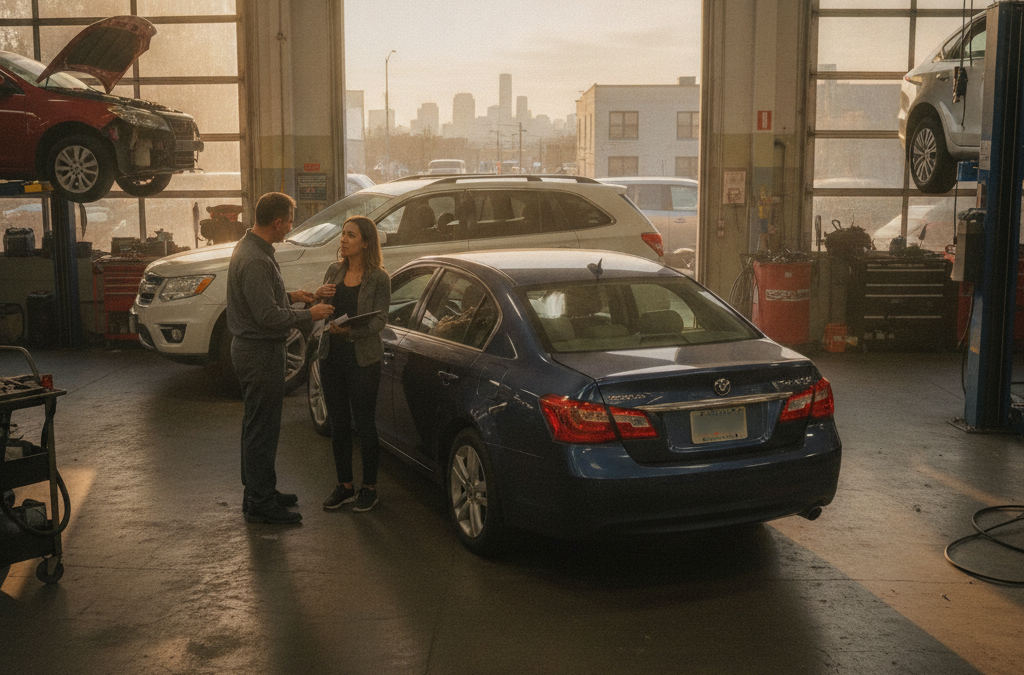
What Bronx and Queens Drivers Should Know About Getting a Car Repaired After a Parking Lot Accident
Parking lot accidents happen constantly in New York City — and if you drive in the Bronx or Queens, you already know how tight things get around busy shopping centers, garages, and street-side lots. You come back to your car and there’s a fresh dent in your door, a scraped bumper, or worse, someone backed into your front quarter panel and drove off without a word. It’s frustrating, and the question most drivers have is simple: what do I do now, and how do I get my car fixed without this becoming a nightmare?
The good news is that parking lot damage — while annoying — is usually very repairable, and you have more options than you might think. Here’s what you need to know from someone who’s been handling exactly this kind of damage in the Bronx for over 50 years.
Step One: Don’t Skip the Documentation
Before you call a shop or your insurance company, take photos. Photograph every angle of the damage, the surrounding area of the parking lot, and any nearby security cameras you can spot. If the other driver is still there, get their name, insurance information, license plate, and a photo of their driver’s license if they’ll allow it. If there are witnesses nearby, ask for a name and phone number.
If the other driver left without leaving a note — which happens all the time in New York City — you’ll want to file a police report. This matters more than people realize. In New York State, a police report creates a paper trail that can support your insurance claim and, in some cases, help with a hit-and-run uninsured motorist claim. Don’t skip this step just because the damage looks minor.
Should You File an Insurance Claim for Parking Lot Damage?
This is one of the most common questions we hear, and the honest answer is: it depends. If the other driver is identified and was clearly at fault, filing a claim against their liability coverage is usually the cleanest path. If you can’t identify who hit you, you may need to go through your own collision or uninsured motorist coverage — which means your deductible comes into play.
For truly minor cosmetic damage — a small scuff or a shallow door ding — some drivers choose to pay out of pocket rather than involve insurance at all. That’s a personal call based on your deductible, your premium history, and how the damage looks. A quick free estimate from a qualified shop can help you make that decision with real numbers in front of you instead of guessing.
What we’d caution against is assuming the damage is purely cosmetic without getting eyes on it first. Parking lot impacts — especially low-speed bumper hits — can push bumper reinforcement bars, crack mounting brackets, or trigger sensor damage that isn’t obvious from the outside. We’ve seen vehicles come in from Queens and Yonkers that looked like a simple scuff on the outside but had hidden damage to parking sensors or structural bumper components underneath. A proper inspection tells you what you’re actually dealing with.
What the Repair Process Actually Looks Like
Once you bring your car in — or even before you drop it off — a reputable shop will walk you through a free, itemized written estimate that breaks down exactly what needs to be done and why. At S&T Auto Body, we’ve offered free estimates since before most of our customers were born. There should be no pressure and no mystery about what you’re being charged for.
Depending on what’s damaged, parking lot repairs typically fall into a few categories:
- Door dents and dings: Depending on the depth and location, these may be repairable through paintless dent repair techniques or may require filler and repainting. Either way, modern paint-matching technology makes it very hard to tell where the repair was made when done correctly.
- Bumper damage: Scraped or cracked bumper covers are common. Some can be repaired and repainted; others need replacement. If the bumper reinforcement bar behind it was impacted, that needs to go too — it’s a safety component.
- Quarter panel and fender damage: If someone clipped the corner of your car pulling out of a space, you may have damage that extends under the surface. Frame or body alignment checks are part of a thorough estimate.
- Sensor and camera damage: Modern vehicles, especially in the Bronx where EV adoption is climbing fast, are loaded with parking sensors, backup cameras, and ADAS features built into the bumpers. Any bumper repair needs to account for sensor recalibration and functionality testing after the work is done.
Timeline for parking lot repairs varies. Simple dent and paint work can often be completed in a day or two. More involved bumper or panel replacements with sensor recalibration may take three to five days depending on parts availability. We’ll give you a realistic timeframe upfront — not the optimistic number, the real one.
Why This Is One Topic Most Local Shops Don’t Cover Clearly
Here’s something worth pointing out: if you’ve searched around the websites of local collision shops trying to figure out what to do after a parking lot accident, you’ve probably found a lot of generic service pages and not much practical guidance. Most shops — including several competitors in the area — don’t explain the actual decision-making process: when to file a claim, when not to, what parking lot damage can hide, or how sensor recalibration fits into what looks like a simple bumper job.
We think that’s a disservice to drivers. The Bronx and Queens have some of the densest traffic and most competitive parking conditions in the country. Parking lot accidents aren’t edge cases — they’re a daily reality. You deserve clear information, not a wall of service keywords.
If you want to understand your full range of collision and mechanical repair options, including what a proper post-accident inspection covers, that’s a good place to start.
Parking Lot Accidents and Luxury or EV Vehicles
If your vehicle is a Tesla, Mercedes-Benz, or another high-end model, parking lot damage deserves extra attention. These vehicles use aluminum-intensive body construction, proprietary sensor systems, and manufacturer-specific repair protocols that most generic body shops aren’t equipped to follow properly. A dented aluminum door panel on a Tesla, for example, can’t be repaired the same way a steel door on a conventional sedan would be.
If you drive an EV or a luxury brand, make sure the shop you choose has the appropriate manufacturer certifications and the trained technicians to back them up. Getting that wrong on a parking lot repair can affect your vehicle’s value, your warranty, and — if sensors weren’t properly recalibrated — your safety. You can learn more about what manufacturer-certified repair involves on our certified repair page.
What to Ask the Shop Before You Commit
Not all body shops handle parking lot repairs the same way. Before you drop your car off anywhere, ask these questions:
- Will you provide a written, itemized estimate before any work begins?
- Do you check for hidden damage behind the bumper or panel, or just quote what’s visible?
- If my car has parking sensors or cameras in the affected area, do you recalibrate them after the repair?
- Are your technicians I-CAR certified?
- Do you work directly with my insurance company, or do I have to manage the claim myself?
At S&T Auto Body, the answers to all of those are yes. We’re I-CAR Gold Class certified, we work with Geico and other major NYC-area insurers, and we’ve been doing this in the Bronx since 1975. We’re not going to cut corners on a parking lot repair any more than we would on a major collision job — because the vehicle you drive home is still the one keeping you safe on the Cross Bronx Expressway or the LIE.
Frequently Asked Questions
Does a parking lot accident go on my driving record in New York?
Generally, no — a parking lot accident where you were parked and not moving doesn’t go on your driving record as a moving violation. However, if an insurance claim is filed, it may appear in your claims history and could affect your premium at renewal. This is worth factoring into your decision about whether to file or pay out of pocket for minor damage.
What if the person who hit me left a note but their insurance won’t cover it?
This happens. If the other driver’s insurance disputes liability or the other party doesn’t have valid coverage, you may need to go through your own collision coverage. Document everything from the start — photos, the note, witness information — so you have a full record to support your claim.
Can parking lot damage be repaired the same day?
Simple repairs — a shallow ding, a small paint scuff — can sometimes be turned around quickly. More involved work, especially anything requiring parts orders or sensor recalibration, takes longer. We’ll always give you an honest timeline during your estimate, not an optimistic one that slips later.
I drive a leased car. Do I have to disclose parking lot damage to the leasing company?
Your lease agreement likely includes provisions about damage disclosure and acceptable wear and tear. Unrepaired dents and scrapes typically fall outside acceptable wear, which means you could face charges at lease turn-in. Getting the repair done properly before the lease ends is almost always the better financial move.
Is it worth getting a repair estimate even if I’m not sure I want to file a claim?
Absolutely. A free estimate costs you nothing and gives you real numbers to make an informed decision. You’ll know whether the damage is truly minor or whether there’s something underneath worth addressing, and you’ll be in a much better position to decide whether insurance is worth involving.
Get a Free Estimate — No Pressure, No Obligation
If you’ve got parking lot damage and you’re not sure where to start, come see us. You can bring the car in, or send us photos to get a preliminary look before you make any decisions. We’ve been helping Bronx and Queens drivers navigate exactly these situations for decades — the small stuff and the major collisions alike.
Reach out through our contact page to request a free estimate or ask us a question. We’ll give you a straight answer, not a sales pitch.