
What Bronx and Garden City Drivers Should Know About Repairing a Car With Bumper, Grille, or Front-End Damage
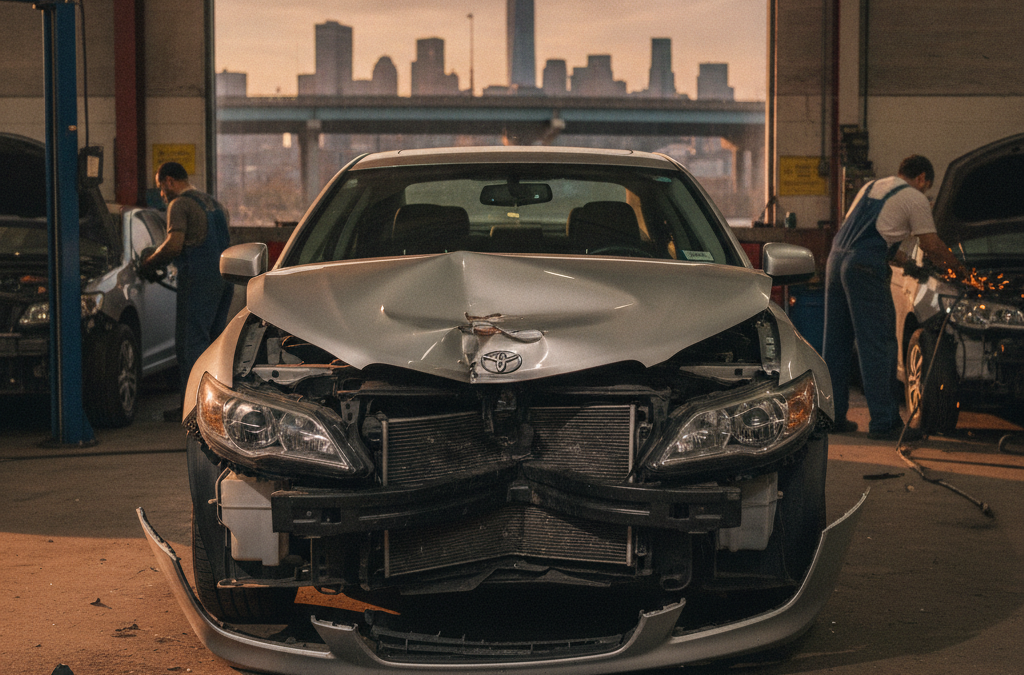
Front-end damage is probably the most common thing we see walk through our doors — and it’s also one of the most commonly mishandled repairs in the NYC metro area. Whether you rear-ended someone in stop-and-go traffic on the Cross Bronx Expressway, clipped a concrete barrier in a parking structure, or got tapped by another driver coming out of a side street near Fordham Road, the damage you can see on the outside is rarely the whole story. Before you take your car anywhere, here’s what you should actually understand about bumper, grille, and front-end repair.
Why Front-End Damage Is More Complicated Than It Looks
The bumper cover — the plastic piece you see on the front of your car — is just the outermost layer. Behind it, there’s typically a bumper reinforcement bar made of steel or aluminum, energy absorbers, a mounting bracket system, and on modern vehicles, a cluster of sensors, cameras, and radar units that power your car’s safety features. Hit something hard enough, and damage can travel back through all of those layers, even if your bumper cover looks fine or only has a small crack.
We’ve seen cars come in from Garden City, Queens, and right here in the Bronx where the driver was convinced it was just a cosmetic fix — and once we got into it, the radiator support was bent, or the cooling fan shroud was cracked, or an ADAS sensor was sitting at the wrong angle. None of that is visible from the outside. That’s why a proper front-end repair starts with a full teardown inspection, not just a glance at the bumper.
The Parts That Can Be Damaged in a Front-End Collision
When you bring your car in for a front-end estimate, a thorough shop should check all of the following — not just what’s obviously cracked or bent:
- Bumper cover — the outer plastic panel. Can often be repaired if damage is minor; replaced if cracked through or heavily deformed.
- Bumper reinforcement bar — the structural bar behind the cover. This absorbs impact energy and must be replaced if it’s bent or crushed, even slightly.
- Energy absorbers / foam inserts — these compress during a low-speed hit and do not return to their original shape. They look fine but may be fully compromised.
- Radiator and condenser — even a modest hit can push a bumper back far enough to puncture or crack the radiator. If your car is running warm after an accident, this is likely why.
- Grille and grille surround — the grille itself is often replaceable as a unit, but the mounting brackets and surround can be a more involved fix on newer vehicles.
- Hood latch and hood alignment — a front impact can shift the hood latch or distort the hood gaps, which affects both safety and appearance.
- ADAS sensors and cameras — forward collision warning, adaptive cruise control, lane keep assist, and automatic emergency braking all depend on sensors mounted in and around the front bumper. These must be recalibrated after any front-end repair, not just replaced.
- Headlights and mounting brackets — headlights on modern vehicles are expensive. Even if the lens is intact, the bracket or wiring harness can be damaged in a front-end hit.
This is a much longer list than most drivers expect — and it’s a list that a lot of shops don’t walk you through up front. At S&T Auto Body, we provide a free itemized estimate that breaks down every component we inspect and every repair we recommend, so there are no surprises when you come to pick up your car.
The Part Most Body Shops Gloss Over: Sensor Recalibration
This is the section that most local competitors aren’t covering in detail — and it’s the part that matters most for drivers of newer vehicles.
If your car was built in the last several years, it almost certainly has a forward-facing camera or radar sensor integrated into the front bumper assembly. These systems — sold under names like Honda Sensing, Subaru EyeSight, Toyota Safety Sense, Ford Co-Pilot360, and others — use precise angles and positions to function correctly. If a bumper is replaced or even removed and reinstalled, those sensors can be physically off by a few millimeters. That’s enough to cause false alerts, delayed braking responses, or complete system deactivation.
Proper recalibration requires a target board, a level surface, and manufacturer-specific software. It is not something every shop can perform. If you drive a certified vehicle — a Subaru, a Ford, a Hyundai, a Mercedes-Benz, or any manufacturer we’re certified with — the recalibration must be done to factory spec to keep your warranty and your safety systems valid. When you’re choosing a shop, ask directly: do you perform in-house ADAS recalibration after front-end repairs? If they pause or hedge, that’s your answer.
What a Front-End Repair Timeline Actually Looks Like
Straightforward bumper cover replacements — where only the outer cover is damaged and the structure behind it is clean — can sometimes be completed in one to two days. Once you factor in parts availability, paint matching, and any supplemental damage uncovered during teardown, a more typical front-end repair runs three to five business days. If there’s radiator damage, significant structural work, or sensor recalibration involved, plan for closer to a week.
Parts availability is a real issue right now across the NYC metro area. Certain components for newer EVs and luxury vehicles can have longer lead times. We’ll always tell you that upfront so you can plan accordingly and coordinate with your insurance company about rental coverage if needed.
Speaking of insurance — front-end collisions are typically straightforward claims, but supplement disputes can come up when teardown reveals additional damage the initial estimate didn’t capture. We handle that communication directly with your insurer, including Geico and other major carriers we work with, so you don’t have to be the go-between.
Does Your Car’s Make or Model Change the Repair Process?
Yes — significantly, in some cases. Aluminum-intensive vehicles like many BMWs, Audis, and Tesla models require different repair techniques than traditional steel-bodied cars. Aluminum doesn’t respond to conventional pulling and hammering methods. It requires specialized equipment and trained technicians who know how aluminum behaves under stress.
Tesla and EV front-end repairs add another layer. The high-voltage systems in electric vehicles require that the car be properly isolated before any structural work begins. At S&T, our EV repair team follows high-voltage safety protocols on every EV that comes through, even for front-end work that doesn’t appear to involve the battery or powertrain. That’s not optional — it’s just how you do it right.
For drivers coming to us from Nassau County, including Garden City, know that we see a strong mix of German luxury vehicles, Japanese makes, and EVs from that area. Whatever the manufacturer, we have the certifications to handle the repair to factory standards.
Frequently Asked Questions
Can a cracked bumper just be repaired instead of replaced?
Sometimes, yes. Minor cracks in the plastic bumper cover can be professionally repaired and repainted to match the rest of the vehicle. Whether repair or replacement makes more sense depends on the size and location of the crack, the material, and the vehicle. We’ll tell you honestly which approach is right for your car — not whichever is more profitable for us.
Do I have to get a front-end repair if the damage seems minor?
Legally, no. But practically, it matters. Even cosmetic front-end damage can affect resale value significantly. And if there’s hidden structural or sensor damage you haven’t found yet, driving on it can create safety issues. A free estimate costs you nothing, and it gives you the full picture before you decide.
Will my insurance cover front-end collision damage in New York?
If another driver caused the accident, their liability coverage should pay. If it was your fault or an unknown cause, your collision coverage applies — subject to your deductible. New York is a no-fault state for personal injury, but property damage claims still follow standard liability rules. We can help you navigate the claim process from estimate through settlement.
Do I need to take my car to a dealership for front-end repairs on a newer model?
No. A manufacturer-certified independent body shop can perform repairs to the same standards as a dealership — and in many cases, with faster turnaround and better communication. Our manufacturer certifications cover a wide range of makes, and we’re required to use OEM parts and follow brand-specific repair procedures to maintain those certifications.
What if I’m in Pelham Bay or another Bronx neighborhood far from your shop — can I still get an estimate?
Yes. You can submit photos of the damage through our contact page and we’ll give you a preliminary estimate before you come in. Drivers from all over the Bronx — Fordham, Pelham Bay, and beyond — do this regularly to get a sense of scope before committing to a tow or drive-in.
Get a Straight Answer Before You Commit to Any Shop
Front-end damage is stressful, especially when you’re not sure how serious it is or how long you’ll be without your car. At S&T Auto Body, we’ve been doing this for 50 years in the Bronx. We’ll give you an honest, itemized look at exactly what’s damaged and what it takes to fix it right — no pressure, no runaround.
If you’re dealing with bumper, grille, or front-end damage anywhere in the Bronx, Garden City, Queens, Manhattan, or surrounding areas, reach out and let us take a look. Request your free estimate here or call us at (718) 220-2201. We’re here to get you back on the road safely — and to make sure the car you get back is actually fixed, not just looking fixed.