What Bronx and Nassau County Drivers Should Know About Paint Matching After a Collision Repair
If you’ve just been in a collision and you’re worried your car is going to come back from the body shop looking like a patchwork quilt — one panel noticeably different from the rest — that concern is completely valid. Paint matching after a collision repair is one of the most technically demanding parts of the job, and it’s one of the things that separates a shop that truly knows what it’s doing from one that’s just going through the motions. At S&T Auto Body in the Bronx, we’ve been matching paint for over 50 years, and we’ll walk you through exactly what’s involved so you know what to expect and what questions to ask.
Why Paint Matching Is Harder Than It Sounds
Your car rolled off the assembly line with a paint code — a specific formula your manufacturer used on that vehicle. Simple enough, right? The problem is that automotive paint changes over time. Sun exposure, car washes, road salt, and everyday wear all shift the color, gloss, and texture of your original finish. By the time you bring a three- or four-year-old car in after a fender-bender on the Cross Bronx Expressway, the paint on your undamaged panels has already aged away from that original factory code.
A shop that just plugs in your paint code and sprays is going to deliver a panel that looks noticeably different — especially in sunlight. That’s the most common complaint drivers in the Bronx and across Nassau County have after a collision repair: the work looks fine in the shop’s lighting, but outside it’s obvious something was fixed. That’s a paint matching failure, and it shouldn’t happen at a shop that takes this seriously.
How Real Paint Matching Actually Works
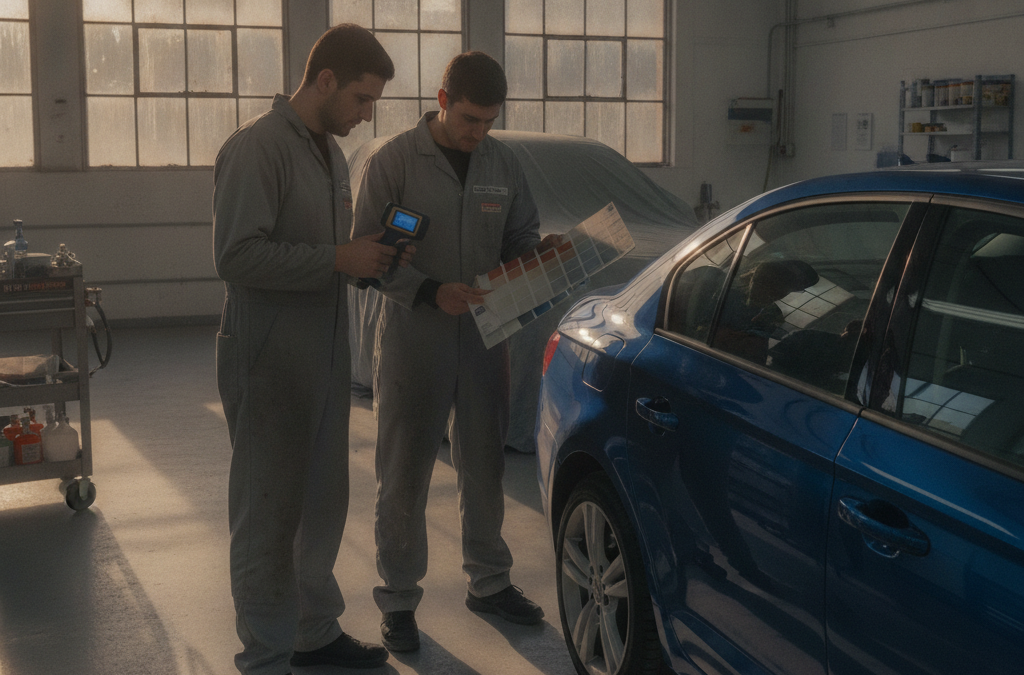
The process starts before a single drop of paint is mixed. At S&T Auto Body, we use a combination of spectrophotometer readings — that’s a tool that scans your existing paint and measures its exact color values — alongside your vehicle’s paint code and our technicians’ hands-on experience with how that specific color behaves on real vehicles under real conditions.
From there, we adjust the formula to account for how your paint has aged. That adjustment is part science, part craft — and it’s the part that separates shops with seasoned, I-CAR Gold Class certified technicians from shops that rely entirely on automated systems. Our painters have been doing this long enough to know that a five-year-old Pearl White on a Tesla in Pelham Bay is going to read differently than the same code on a brand-new vehicle. You account for that, or you don’t get a true match.
Blending: The Step Many Shops Skip
Even with a perfect color mix, matching paint on a single panel in isolation is rarely enough. That’s why professional shops blend the new paint into the adjacent panels — feathering the transition so your eye can’t detect where the repair ends and the original finish begins. This takes more time and more materials, which is why some shops skip it or do it poorly to cut costs.
If a shop gives you an estimate that seems unusually low and doesn’t mention blending, ask about it directly. On a solid color like black or white, you might get away without blending on a small repair. On metallics, pearls, or tri-coat finishes — which are common on Mercedes-Benz vehicles, many Lexus and Infiniti models, and nearly all current EVs — skipping the blend is almost guaranteed to produce a visible mismatch.
Paint Matching on EVs and Luxury Vehicles: A Different Ballgame
If you drive a Tesla, a Mercedes-Benz, or another high-end vehicle, paint matching gets significantly more complex. Tesla, for example, uses multi-stage paint systems and aluminum body panels that require specific application techniques. The paint doesn’t behave the same way it does on traditional steel, and the curing process has to be controlled precisely. A shop without EV-specific training and equipment is going to struggle to get the finish right — and a visible repair on a car like that is a real problem, both aesthetically and for resale value.
Mercedes-Benz paint — especially their designo specialty finishes — involves multiple layers and specific manufacturer-approved products. Getting it wrong doesn’t just look bad; it can void your warranty coverage on that panel. That’s why manufacturer-certified collision repair matters when you’re dealing with a luxury vehicle. The certification isn’t just a wall plaque — it means the shop has met specific standards for equipment, training, and materials that the manufacturer itself has approved.
What Nassau County and Westchester Drivers Often Don’t Realize
We see drivers come to us from Manhasset, White Plains, Yonkers, and all across Nassau County — sometimes after getting a repair done locally that didn’t sit right. Paint mismatch is one of the top reasons. In suburban areas, you’re often dealing with dealership-affiliated shops or regional chains that process high volumes of vehicles quickly. Speed is the priority. Paint matching — the kind that requires real care and a trained eye — can get treated as an afterthought.
If you’re in Morris Park or driving in from Nassau County and you’ve had paint work done before that didn’t match, you already know what we’re talking about. Come in, let us scan the existing paint, and we’ll show you exactly what’s involved before we start. No surprises.
What to Ask Any Body Shop Before You Commit
- Do you use a spectrophotometer or just the factory paint code? If it’s just the code, walk away — especially on any vehicle over two years old or with a metallic or pearl finish.
- Do your painters blend into adjacent panels? On anything other than a basic solid color, the answer should be yes.
- What paint system do you use? Manufacturer-approved materials matter, especially on certified vehicles.
- Can I see examples of your color-match work? A shop confident in their work will have photos or be able to point you to completed vehicles.
- Are your technicians I-CAR certified? I-CAR Gold Class training includes current standards for paint application and finishing — it’s a meaningful indicator of shop quality.
At S&T Auto Body, our technicians hold I-CAR Gold Class certification, which means they’re trained to current industry standards — including paint and refinishing. We also offer free itemized estimates so you can see exactly what’s being done and why before any work begins.
Frequently Asked Questions
Will my insurance cover the cost of paint blending?
In most cases, yes — blending is considered part of a proper repair, and reputable insurers including Geico typically allow for it when it’s necessary for a color-accurate result. Your estimate should itemize blending as a line item. If a shop isn’t including it and your vehicle has a metallic or pearl finish, ask why.
How long does paint work take?
A single-panel repair with blending typically adds one to two days to the overall repair timeline depending on the vehicle and finish type. Multi-panel jobs or tri-coat finishes take longer. We’ll give you a realistic timeline upfront — not a number designed to get you to sign and then change later.
Can paint mismatch be fixed after the fact?
Sometimes, yes — through re-blending or refinishing the affected area. But it’s far better to get it right the first time. If you’ve had a repair done elsewhere and the color doesn’t match, bring it in and we’ll assess what’s involved in correcting it.
Does paint matching work the same on EVs?
The color-matching process is similar, but the materials and application technique are different. EV body panels — especially aluminum — require specific primers and paint systems. The curing process may also differ. Make sure your shop has EV-specific training before letting them touch the finish on a Tesla or similar vehicle.
What’s a tri-coat finish and why is it harder to match?
A tri-coat finish has three layers: a base coat (often a solid color), a mid-coat (often the pearl or metallic effect), and a clear coat on top. Each layer has to be matched and applied correctly for the final result to look right. It’s one of the most technically demanding paint jobs in the industry, and it’s increasingly common on luxury vehicles and EVs.
Get It Done Right the First Time
Paint matching isn’t glamorous, but it’s one of the most visible indicators of whether a shop truly cares about the finished product. A car that comes back with a panel that doesn’t match is a car that looks damaged even after it’s been repaired — and that’s not acceptable to us or to you.
If your car was just in a collision and you want to know exactly what’s involved in getting the finish right, we’re happy to walk you through it. Request a free estimate from S&T Auto Body — we’ll take a look at your vehicle, scan the existing paint, and give you a straight answer about what a proper repair looks like. No pressure, no runaround. Just honest work from a shop that’s been doing this in the Bronx since 1975.