What Bronx and White Plains Drivers Should Know About Getting a Tesla or EV Repaired After a Collision
If your Tesla or electric vehicle was just in a collision — even a moderate one — you cannot take it to just any body shop and expect it to be fixed correctly. This is true whether you’re driving through Riverdale, sitting in Cross Bronx Expressway traffic, or commuting down from White Plains into the city. EVs, and Teslas in particular, have structural designs, battery systems, and repair requirements that are fundamentally different from conventional vehicles. A shop that doesn’t have the right training, equipment, and certifications can make a bad situation much worse. Here’s what you need to know before you choose where to send your car.
Why a Regular Body Shop Isn’t Enough for a Tesla or EV
It’s not about snobbery toward smaller shops — it’s about physics and engineering. Tesla builds its vehicles with large aluminum body structures, not the steel frames most technicians trained on for decades. Aluminum behaves differently under impact. It doesn’t bend and spring back the way steel does. If it’s worked incorrectly — using steel repair tools, for instance — it can become structurally compromised in ways you can’t see from the outside. The car may look fine and still be dangerous to drive.
Then there’s the battery pack. In a Tesla Model 3, Model Y, or Model S, the battery runs along the entire floor of the vehicle. In a rear-end collision, a side impact, or even a hard fender-bender, that pack can be damaged. A shop that doesn’t understand high-voltage safety protocols puts its technicians — and you — at real risk. Working around a live high-voltage system without the right procedures is not something you want someone learning on your car.
Tesla’s certified body shop program exists for exactly this reason. Shops in that network are required to complete manufacturer-specific training, use Tesla-approved repair procedures, and have the diagnostic tools necessary to interface with the vehicle’s systems. S&T Auto Body’s EV repair program is built around these standards — including high-voltage safety protocols and aluminum-specific repair techniques.
What the Collision Repair Process Actually Looks Like for an EV
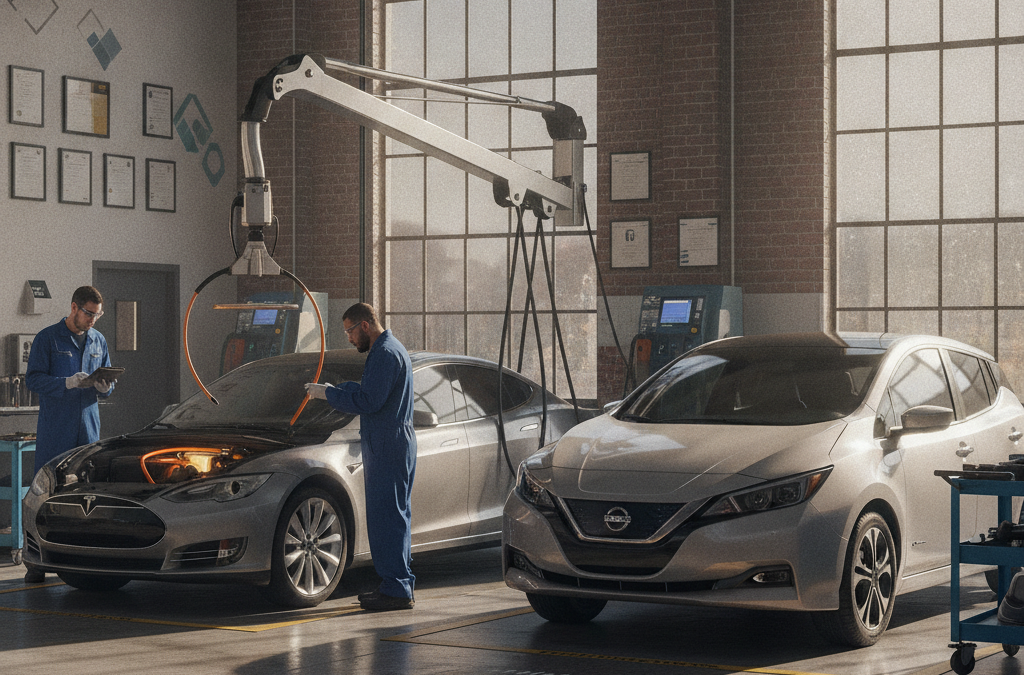
When your Tesla or EV comes into a qualified shop after a collision, the process starts differently than it does for a gas-powered car. Before any bodywork begins, the vehicle’s battery system has to be properly assessed and, in many cases, safely de-energized. That’s not a step you can skip or rush.
After that, technicians use manufacturer-approved procedures to evaluate structural damage — including areas of the aluminum frame that absorbed impact energy. Modern EVs are designed to crumple in specific ways to protect passengers and the battery pack. Restoring that designed behavior requires precision, not improvisation.
From there, the process looks more familiar: damaged panels are repaired or replaced, paint is matched to the vehicle’s specific finish, and any sensors — cameras, ultrasonic sensors, radar — that were affected by the collision are recalibrated. Tesla’s vehicles in particular are heavily reliant on cameras for Autopilot and safety systems, so a shop that replaces a bumper or fender without addressing sensor alignment is leaving the job unfinished.
What Most Local Competitor Shops Don’t Tell You About EV Repairs
Here’s something worth knowing: many body shops in the Bronx and Westchester area will take your EV without disclosing that they aren’t certified or specifically trained for it. They’ll accept the job, do their best with general collision repair knowledge, and return the car looking fine on the surface. The problem is what you can’t see.
We looked at what several local competitors publish online about EV repair. Most of them say almost nothing about it — no mention of high-voltage training, no discussion of aluminum-specific repair methods, and no transparency about whether their technicians have completed any manufacturer-approved EV coursework. That silence matters. When a shop doesn’t tell you how they handle EV repairs, it often means they handle them the same way they handle everything else — which isn’t good enough for a vehicle running a 400-volt battery system.
At S&T Auto Body, we’re straightforward about our process. Our I-CAR Gold Class certified technicians train specifically on EV and Tesla repair procedures. If you bring us your Model Y or a newer EV from another manufacturer, you’ll get a clear explanation of what the repair involves — not a vague promise that it’ll look good when you pick it up.
Insurance Claims for Tesla and EV Repairs in the Bronx and Westchester
One thing EV owners often don’t anticipate is how insurance claims work differently for these vehicles. Parts can take longer to source. Repair labor rates for certified EV work tend to be higher than for conventional vehicles — and for good reason. If your insurer is pushing you toward a shop they prefer that isn’t EV-certified, you have the right to push back.
In New York State, you can choose your own repair shop after an accident. You are not legally required to use a shop your insurer directs you to. If you’re filing through Geico or another major carrier, S&T Auto Body can work directly with them on your behalf to document the repair scope and advocate for the use of proper parts and certified procedures. Our collision repair process includes helping you navigate that conversation so you’re not left fighting your insurer alone while your car sits on a lot.
Drivers coming in from White Plains, Yonkers, and the rest of Westchester County often deal with the same insurance complexities as Bronx residents — and the same shortage of truly qualified EV repair facilities nearby. We regularly work with EV owners from across the region who couldn’t find a certified shop closer to home.
Questions to Ask Before You Commit to Any Shop
Whether you end up at S&T Auto Body or somewhere else, make sure you’re asking these questions before you sign anything:
- Are your technicians trained and certified specifically for Tesla or EV repair? Ask for specifics — not just a yes.
- Do you have the equipment to work with aluminum body structures? Aluminum requires dedicated tools that steel shops may not have.
- How do you handle the high-voltage battery system during repairs? There should be a clear answer about de-energizing procedures.
- Will you recalibrate any cameras or sensors affected by the collision? This is critical for vehicle safety systems.
- Can you provide a written, itemized estimate? Any reputable shop should be able to do this before work begins.
If a shop gives you vague answers or seems annoyed by the questions, that tells you what you need to know.
Frequently Asked Questions
Can any body shop legally repair a Tesla after a collision in New York?
Legally, yes — but not safely in every case. Tesla’s certified shop program exists because their vehicles require specific training and equipment. A non-certified shop working on a Tesla may return the car looking repaired without addressing structural or battery-related damage correctly.
Will my insurance cover EV-certified repair costs, or will they push me to a cheaper shop?
Your insurer may try to direct you to a preferred shop. In New York State, you have the right to choose your own repair facility. A qualified shop can help document why certified repair procedures are required and work directly with your insurer to make the case.
How long does Tesla or EV collision repair typically take in the Bronx area?
It varies based on damage severity and parts availability. EV parts — especially Tesla components — can sometimes take longer to source than conventional parts. A shop should give you a realistic timeline upfront, not a number designed to get you to sign paperwork.
I drive a non-Tesla EV — a Hyundai Ioniq or Volkswagen ID.4, for example. Does this still apply?
Yes. Most modern EVs share similar challenges: aluminum or mixed-material body construction, high-voltage battery systems, and advanced driver assistance sensors that require recalibration after a collision. S&T Auto Body holds certifications across multiple manufacturers, including Hyundai and Volkswagen, so your non-Tesla EV isn’t left in the hands of someone guessing at the repair.
Do I need to go back to the dealership for EV body repairs?
No. A certified independent collision center can perform the same manufacturer-approved repairs as a dealership body shop — often with faster turnaround and more personal service. The key is certification, not whether the shop has a dealership badge on the wall.
Get a Free Estimate From a Shop That Actually Knows EVs
S&T Auto Body has been serving the Bronx and the surrounding area since 1975. We’re a family-owned shop — not a chain — and we’ve invested in the training, equipment, and certifications required to repair today’s electric vehicles the right way. If your Tesla, Ioniq, ID.4, or any other EV was in a collision, don’t let it sit at a shop that’s figuring things out on the fly.
Reach out to us at our contact page to request a free, no-obligation estimate. You can submit photos of the damage before you even come in. We’ll give you a straight answer about what the repair involves, what it will take, and how we can help you work through the insurance process — so you can get back on the road with confidence.