What Does Frame Damage Really Mean for Your Car After a Bronx Collision?
If you’ve just been told your car has frame damage after a collision in the Bronx, that phrase can sound a lot scarier than it needs to — or sometimes not scary enough. The truth lands somewhere in the middle, and it depends heavily on what kind of damage you’re actually dealing with and who’s doing the repair. Before you panic, or before you sign off on a repair at a shop that glosses over the details, here’s what you actually need to know.
What “Frame Damage” Actually Means in a Modern Car
Most vehicles on the road today — sedans, crossovers, many SUVs — don’t have a traditional body-on-frame construction like an old pickup truck. They’re built on what’s called a unibody, where the body and structure are one integrated piece of steel (or in some EVs and luxury vehicles, aluminum). When technicians say “frame damage,” they’re usually referring to structural deformation somewhere in that unibody — a bent rail, a crushed crumple zone, a misaligned door opening, or a twisted rocker panel.
This matters because unibody damage isn’t always obvious from the outside. A car can look drivable after a hard impact on the Cross Bronx Expressway and still have structural measurements that are off by millimeters — enough to affect how your airbags deploy in the next accident, how your tires wear, or how your doors seal. That’s why a proper post-collision inspection isn’t just about what you can see.
The Difference Between Repairable Frame Damage and a Total Loss
This is the question most people actually want answered, and it’s also where a lot of shops in the NYC area are vague. Here’s the honest breakdown:
- Repairable damage typically means the structural rails, pillars, or floor pan can be measured, pulled back into spec on a dedicated frame straightening machine, and verified against the manufacturer’s original dimensions. If the metal can be returned to factory tolerances and isn’t compromised in a way that creates a safety risk, it can be fixed right.
- Damage that’s too severe to repair usually involves a collapsed safety cage, multiple overlapping bends in primary structural members, or damage to areas that simply cannot be straightened without weakening the surrounding metal. In those cases, the insurer may declare the vehicle a total loss — not because frame damage is automatically a write-off, but because the cost of correct repair exceeds the vehicle’s value.
What you want to avoid is the gray area — a shop that calls something “repaired” when it was really just massaged back into place without proper measurement verification. That’s a safety problem and a resale problem, and it shows up on a Carfax when you go to sell the car.
How Frame Straightening Actually Works
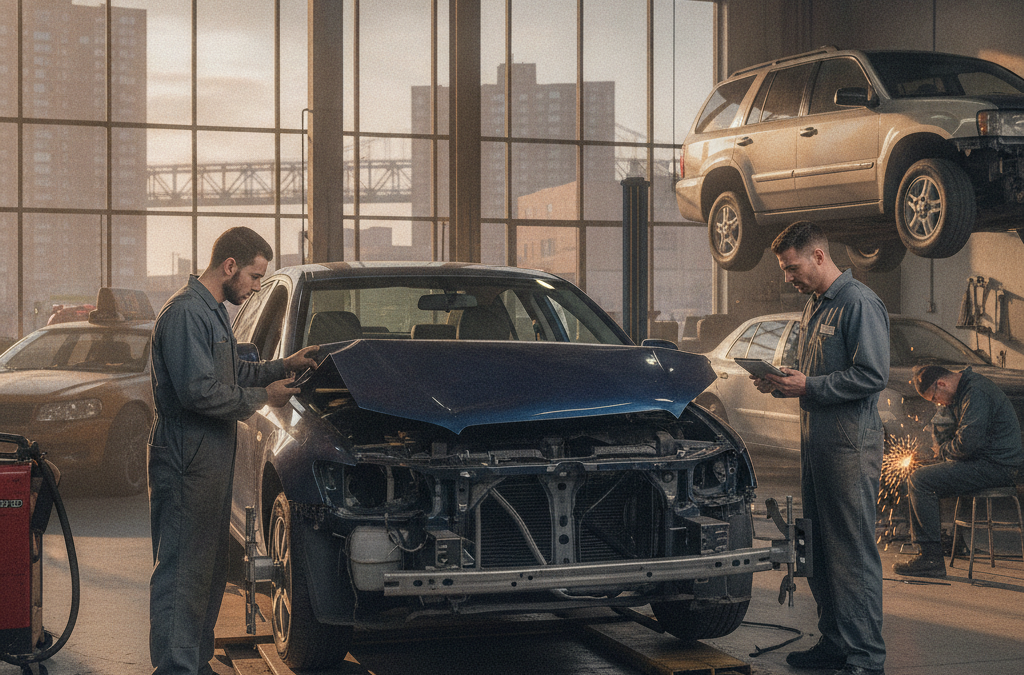
Legitimate structural repair starts with putting your vehicle on a computerized measuring system — equipment that maps the actual dimensions of your car’s structure against the manufacturer’s published specs. Every make and model has tolerances, and a real structural repair has to hit those numbers, not just look straight to the eye.
From there, technicians use a frame straightening rack — a hydraulic system that applies precisely controlled force to bent or deformed sections — to bring the structure back into alignment. For some vehicles, especially those with aluminum-intensive construction (think newer Teslas or certain Mercedes-Benz models), this process requires brand-specific training and tooling, because aluminum behaves differently than steel under stress and cannot be heat-treated the same way.
After straightening, the car goes back on the measuring system to confirm the numbers. Then — and only then — does the rest of the repair proceed: panel replacement, welding, paint, and reassembly. Skipping or shortcutting any of these steps is where structural repairs go wrong. Our collision and mechanical repair process follows these steps exactly, because that’s what safe, complete repair actually looks like.
Why This Is a Gap Most Local Shops Don’t Talk About Clearly
If you spend time reading through competitor sites in the NYC area, you’ll notice something: most of them mention frame repair in a sentence or two, usually buried under a list of services. There’s almost no explanation of what the process involves, what equipment is required, or how a customer is supposed to know whether the repair was done right. That’s a problem when you’re a driver who just got sideswiped on Fordham Road and doesn’t know the first thing about unibody construction.
We think you deserve a straight answer. Frame repair done properly — with a computerized measuring system, by technicians who have current I-CAR training — is a legitimate, safe repair. Frame repair done badly is a liability. The difference is in the shop’s equipment, training, and willingness to show you the before-and-after measurements.
What Your Insurance Company Needs to Know
Structural damage claims are more involved than a simple fender bender. Your insurer — whether that’s Geico, Allstate, or anyone else — will typically want a detailed estimate that itemizes the structural work separately from cosmetic repairs. If you’re filing a claim, make sure the shop you choose can produce a clear, written estimate that breaks down what structural repairs are being performed and what measuring system will be used to verify the result.
Drivers coming to us from Yonkers, White Plains, Mount Vernon, and Queens have all run into the same situation: an insurer pushes them toward a preferred shop, and that shop gives a vague estimate that doesn’t clearly describe the structural work. You have the right to choose your own shop in New York State, and you have the right to a complete written estimate before any work begins. Don’t let anyone rush you past that step.
Does Frame Damage Always Affect Resale Value?
Honestly — yes, to some degree. Disclosed structural damage does affect a vehicle’s market value, and it will appear on a vehicle history report. What minimizes that impact is having the repair done correctly, documented thoroughly, and completed by a certified shop. A repair that’s backed by I-CAR-trained technicians and verified with computerized measurements is a very different story than a repair that isn’t. Buyers, dealerships, and insurers know the difference.
If you’re driving a newer vehicle — a Tesla, a Mercedes, or another make where we hold manufacturer certification — proper structural repair also matters for keeping your manufacturer certification standards intact and protecting your vehicle’s safety systems going forward.
Frequently Asked Questions About Frame Damage in the Bronx
Can a car with frame damage be driven?
It depends on the severity. Minor structural deformation might not immediately affect driveability, but it can affect how the vehicle handles, how tires wear, and how safety systems perform in a future crash. Get it inspected before making that call — don’t assume it’s fine because it drives straight.
How long does frame straightening take?
Structural repair typically adds one to several days to a repair timeline, depending on the extent of damage and whether other repairs are happening simultaneously. A shop that tells you frame work is done same-day without a clear explanation is worth questioning.
Will my insurance cover frame damage?
If the damage was caused by a covered collision or comprehensive event, yes — your insurance should cover structural repair as part of the claim. The key is making sure the estimate captures all the structural work, not just the cosmetic stuff. An itemized estimate is your protection here.
Is frame damage a reason to total a car?
Not automatically. Insurers look at total repair cost versus actual cash value of the vehicle. Frame damage can push a repair into total loss territory on older or lower-value cars, but on a newer vehicle it’s often fully repairable when addressed by a properly equipped shop.
How do I know if a shop’s frame repair is actually certified?
Ask directly whether their technicians hold current I-CAR training, and ask what measuring system they use to verify structural alignment before and after repair. A shop that can’t answer both questions clearly isn’t the right shop for structural work. You can also check a shop’s certifications — ours are listed on our certifications page so you don’t have to take our word for it.
Get a Straight Answer Before You Commit to Any Repair
Frame damage is serious, but it’s not automatically a disaster. What matters is finding a shop that will be honest with you about what the damage actually is, show you the numbers, and stand behind the repair. S&T Auto Body has been doing structural collision repair in the Bronx for 50 years. We don’t sugarcoat estimates, and we don’t cut corners on structural work — because we know the car you get back has to keep you and your family safe on some of the most congested roads in the country.
If your car has been in a collision and you’ve been told there’s frame damage — or you just want a second opinion — contact us for a free, itemized estimate. We’ll tell you exactly what we’re seeing, what it takes to fix it right, and what your options are. No pressure, no runaround.