What Bronx and Scarsdale Drivers Should Know About Getting Their Car’s ADAS Features Recalibrated After a Collision
Yes — if your car was in a collision and it has modern safety technology like automatic emergency braking, lane-keeping assist, blind-spot monitoring, or a forward-facing camera, those systems almost certainly need to be recalibrated before you drive that car again. This is true even when the damage looks cosmetically minor. A bumper replacement, a windshield swap, or an airbag deployment can all shift the sensors just enough to make those systems unreliable — sometimes dangerously so. It’s one of the most commonly skipped steps in collision repair, and it’s something drivers in the Bronx, Scarsdale, and across Westchester County need to understand before they sign off on any repair job.
What Are ADAS Features and Why Do They Go Out of Alignment?
ADAS stands for Advanced Driver Assistance Systems. It’s the umbrella term for the suite of sensors, cameras, and radar units that modern vehicles use to assist — and in some cases override — the driver. Think of the camera mounted behind your rearview mirror that watches for lane markings, the radar sensor hidden in your front bumper that triggers automatic braking, or the ultrasonic sensors in your rear fascia that warn you when you’re backing toward something. These components are calibrated to extremely precise tolerances at the factory. When a collision moves a bumper cover, replaces a windshield, or changes the alignment of the front end — even slightly — that calibration can be off.
And when it’s off, the system doesn’t work the way it’s supposed to. Lane departure warnings may trigger at the wrong moment or not at all. Automatic emergency braking might not engage until it’s too late. Adaptive cruise control might maintain the wrong following distance. These aren’t theoretical risks. They’re the kinds of failures that lead to secondary accidents — often worse than the original one.
This Is Especially Important for EV and Luxury Vehicle Owners
If you’re driving a Tesla, Mercedes-Benz, or another late-model EV or luxury vehicle, ADAS recalibration isn’t optional — it’s built into the manufacturer’s repair standards. Tesla’s Autopilot cameras and radar systems require precise calibration procedures that can only be completed with manufacturer-approved equipment and software. A shop that doesn’t have access to that equipment simply cannot do the job correctly. The same applies to Mercedes-Benz vehicles, where systems like DISTRONIC adaptive cruise control and Active Lane Keeping Assist require dealer-level calibration tools and certified repair procedures.
We see a lot of drivers from Scarsdale, White Plains, and Yonkers coming to us with late-model luxury and EV vehicles after their regular body shop completed the visible repair — but nobody recalibrated the ADAS systems. The car looks fine. The paint matches. But the lane assist is acting erratically and a warning light is on. Getting it right the first time is always easier than trying to fix it after the fact. You can learn more about our approach to EV and Tesla body repair, including how we handle the sensor and calibration requirements that come with these vehicles.
What Types of Repairs Trigger the Need for Recalibration?
This is where a lot of drivers get caught off guard. You might assume that ADAS recalibration only applies to major collisions. In reality, quite a few routine repairs can disturb sensor alignment enough to require recalibration. Here’s what to watch for:
- Windshield replacement: If your car has a forward-facing camera mounted near the rearview mirror — and most cars built after 2018 do — replacing the windshield almost always requires camera recalibration.
- Bumper repair or replacement: Radar sensors and parking sensors are built into bumper assemblies. Any work on the bumper can shift their position and angle.
- Front-end or suspension work: Changes to alignment, ride height, or steering geometry affect how cameras and radar perceive the road ahead.
- Airbag deployment: In a collision severe enough to deploy airbags, the physical forces involved can move sensors and brackets throughout the vehicle.
- Hood, fender, or grille replacement: On vehicles where radar or lidar sensors are mounted in the front fascia or behind the grille, any work in that area warrants inspection and potential recalibration.
Static vs. Dynamic Calibration — What’s the Difference?
There are two types of ADAS calibration, and different systems require different approaches — or sometimes both.
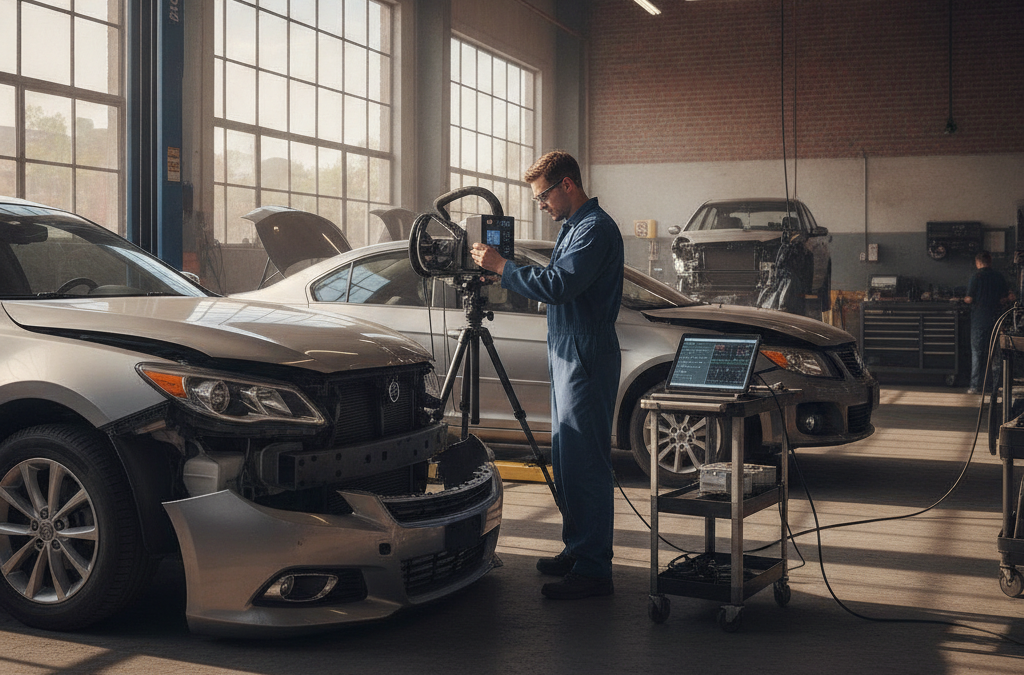
Static calibration is done in a controlled indoor environment. The vehicle is positioned precisely in front of calibration targets — specialized boards or patterns — and technicians use manufacturer-approved software to adjust the system while the car is stationary. This requires enough clear, level space in the shop and the right equipment for the specific vehicle make and model.
Dynamic calibration requires driving the vehicle under specific conditions — usually at a certain speed, on a road with clear lane markings, for a defined distance — while the system calibrates itself using live sensor input. Some manufacturers require both types to be completed in sequence.
Not every shop has the space, equipment, or training to perform both types correctly. This is one of the clearest reasons why manufacturer certification and I-CAR Gold Class training matter. Our technicians are trained to follow manufacturer-specific recalibration procedures for each vehicle we work on, not a generic process that may or may not apply to your car.
What Competitor Shops Often Miss on This Topic
Here’s something worth knowing: most local collision repair shops — including some that advertise extensively online — say almost nothing about ADAS recalibration on their websites or in their repair processes. They’ll mention paint matching, frame straightening, and insurance claims. But the question of what happens to your car’s safety systems after a repair is rarely addressed. That’s a real gap, and it matters to you as a driver.
When you’re getting a collision estimate, ask specifically: Does this repair require ADAS recalibration, and is that included? If the person writing your estimate looks uncertain, that’s important information. A shop with proper manufacturer certifications and trained technicians should be able to answer that question without hesitation and show you the calibration report when the work is done. Our manufacturer certifications cover the specific brands and systems we’re equipped to handle properly.
Does Insurance Cover ADAS Recalibration?
Generally, yes — if the need for recalibration is tied to a covered collision or comprehensive claim, it should be part of what your insurer pays for. The key is documentation. The repair facility needs to properly identify and document which systems were affected and include the calibration procedure in the repair plan. If a shop doesn’t list recalibration on the estimate because they either don’t perform it or don’t know it’s required, you may end up with an uncalibrated system and no coverage path to fix it later.
Working with a shop that knows how to communicate with your insurer — and that documents ADAS work properly — protects you on both ends. We work regularly with Geico and other major NYC-area insurers, and we know how to make sure required calibration steps are included in the approved repair scope, not left off the estimate.
Frequently Asked Questions
How do I know if my car has ADAS features that need calibration?
If your car was built after roughly 2015 and has features like automatic emergency braking, lane departure warning, adaptive cruise control, blind-spot monitoring, or a backup camera, it almost certainly has ADAS components that can require recalibration after certain repairs. Your owner’s manual will list the safety systems on your vehicle. When in doubt, ask the shop directly before the repair starts.
Will a warning light come on if my ADAS sensors are out of calibration?
Sometimes — but not always. Some vehicles will display a warning or disable the affected system. Others will appear to function normally but give inaccurate readings. You should never assume your ADAS systems are working correctly after a collision just because no warning light appeared.
Does windshield replacement always require camera recalibration?
On most vehicles made in the last several years, yes. If your vehicle has a forward-facing camera mounted at or near the windshield — which is required for forward collision warning and automatic emergency braking on most current models — windshield replacement almost always triggers a recalibration requirement. Check with a certified shop before and after the glass work is done.
Can any body shop perform ADAS recalibration?
No. Proper ADAS recalibration requires manufacturer-specific equipment, software, and training. A shop that isn’t manufacturer-certified and doesn’t have I-CAR Gold Class trained technicians may not have what’s needed to do this correctly for your specific vehicle. Always ask what calibration equipment the shop uses and whether they follow OEM procedures.
I drive from Scarsdale into Manhattan every day. Does this affect how seriously I should take ADAS calibration?
Absolutely. Highway driving on the Cross Bronx Expressway, dense urban traffic in Manhattan, and the constant stop-and-go of Queens and Bronx streets are exactly the conditions where ADAS systems are working hardest. A miscalibrated forward-collision system or lane-keeping assist in that kind of traffic environment isn’t just a technical issue — it’s a safety risk for you and everyone around you.
Get It Done Right the First Time
We’ve been taking care of drivers in the Bronx and the surrounding area since 1975. In that time, we’ve watched vehicle technology change dramatically — and we’ve made sure our training and equipment have kept pace. ADAS recalibration is part of how we do collision repair now, not an afterthought.
If you were recently in an accident and you’re not sure whether your car’s safety systems were properly recalibrated — or if you want to get a free estimate before you commit to any shop — reach out to us. We’ll give you a straight answer about what your vehicle needs and make sure the full scope of the repair is documented properly from the start. Contact S&T Auto Body to request your free estimate and talk to someone who knows your car’s systems as well as its sheet metal.