What Bronx and Mount Vernon Drivers Should Know About Getting a Car Repaired When the Shop Uses Aftermarket or Salvage Parts Instead of OEM
If you just got in a collision and a body shop is quoting you a price that seems surprisingly low — or your insurance company’s estimate comes in well under what you expected — there’s a good chance the repair is being written up with aftermarket or salvage parts instead of original equipment manufacturer (OEM) parts. For drivers in the Bronx and neighboring Mount Vernon, this is one of the most common and least-talked-about issues in the collision repair process. It affects your car’s safety, how it holds up down the road, and in some cases whether your manufacturer’s warranty stays intact. Here’s what you need to know before you sign anything.
What’s the Difference Between OEM, Aftermarket, and Salvage Parts?
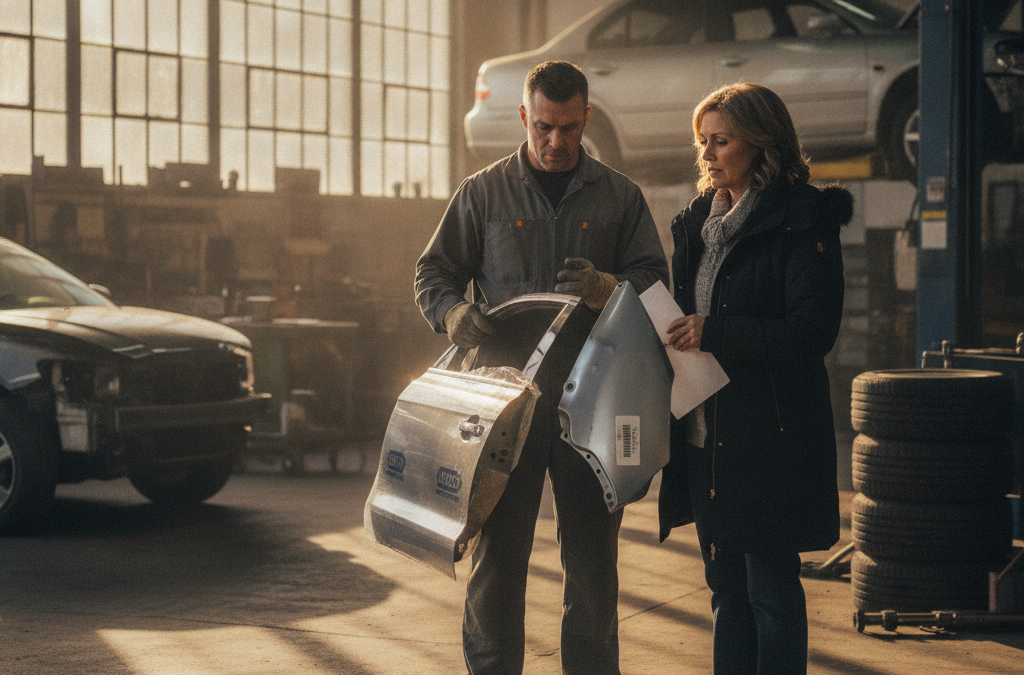
Let’s keep this simple. OEM parts are made by or for your vehicle’s manufacturer — the same parts your car was built with. If your Toyota has a crumpled front fender, an OEM replacement comes from Toyota and is engineered specifically to fit and perform as the original did.
Aftermarket parts are manufactured by third-party companies, not the original automaker. They’re designed to fit a wide range of vehicles and are usually cheaper — sometimes significantly so. Quality varies widely. Some aftermarket parts are fine for low-stress components. Others don’t fit quite right, don’t hold paint the same way, or don’t meet the structural tolerances that matter in a future collision.
Salvage parts — sometimes called used or recycled parts — are pulled from other vehicles, usually ones that have been totaled. A salvage door or quarter panel may look fine on the surface, but you have no way of knowing what that part has been through. It may have hidden stress fractures or corrosion. For structural components especially, that’s a real concern.
Why Insurance Companies Push Aftermarket and Salvage Parts
Insurance companies are in the business of managing costs, and parts are one of the biggest line items in any repair estimate. Many major insurers — including some of the most common carriers in the New York metro area — write estimates that default to aftermarket or salvage parts wherever possible. That’s not necessarily illegal, but it’s something you need to watch for.
Here in the Bronx, where traffic is dense, accidents happen frequently, and many drivers are navigating the claims process for the first time, it’s easy to just accept the insurer’s estimate without realizing what it specifies. The same goes for drivers coming in from Mount Vernon, Yonkers, or New Rochelle — the paperwork moves fast, especially when you’re stressed and just want your car back.
What most drivers don’t realize is that in New York State, you have the right to request OEM parts. Whether your insurer is required to pay for them depends on your policy and the specific circumstances, but you can always ask — and a shop that knows how to negotiate with insurers can push for OEM where it matters most.
When Does It Actually Matter?
Not every part on your car needs to be OEM to be safe or functional. A simple trim piece or a non-structural cosmetic panel replaced with a quality aftermarket part is usually not a big deal. But there are situations where OEM really matters:
- Structural components: Hood, doors, quarter panels, and anything that’s part of your vehicle’s crumple zone — these need to meet exact manufacturer specifications to protect you in a future impact.
- Safety systems: Bumper reinforcements, sensor mounts, and parts that house ADAS components need to be positioned precisely. An aftermarket part that’s even slightly off can affect how a camera or radar sensor reads the road.
- Paint and finish: Aftermarket body panels often don’t hold primer and paint the same way OEM metal does. You may end up with a panel that fades or peels faster, or paint that never quite matches.
- Luxury and EV vehicles: If you drive a Mercedes-Benz, a Tesla, or another vehicle with specialized construction — aluminum body panels, for instance — using non-OEM parts can create fitment problems and void your manufacturer warranty.
What Manufacturer-Certified Shops Do Differently
This is the part that most competitor shops in this area don’t talk about clearly — and it’s exactly why it matters where you bring your car.
When a shop holds manufacturer certifications — for brands like Mercedes-Benz, Tesla, Subaru, Ford, GM, Volkswagen, Hyundai, Toyota, Nissan, Kia, or others — those certifications come with requirements. One of those requirements is using approved parts and repair procedures. A certified shop isn’t just more likely to use OEM parts; in many cases, they’re required to in order to maintain their certification status.
At S&T Auto Body, our manufacturer certifications aren’t something we hang on the wall and forget about. They govern how we write estimates, what parts we order, and how we document the repair for your records and your insurer. When we work on a Mercedes or a certified vehicle from another brand, OEM parts aren’t optional — they’re the standard.
Our I-CAR Gold Class certified technicians are trained to identify when a part substitution would compromise a repair, and to push back on an insurer’s estimate when necessary. That’s part of the job.
How to Protect Yourself Before Your Car Goes Into the Shop
Here are the practical things you should do — or ask about — before authorizing any repair:
- Ask for an itemized estimate. A line-by-line estimate will show you whether each part is listed as OEM, aftermarket (often labeled “CAPA” or “NSF certified”), or LKQ (like kind and quality, meaning salvage). You have a right to see this.
- Ask about your warranty. If your vehicle is still under a manufacturer warranty, using non-approved parts for certain repairs may affect coverage. Your dealer and your body shop should both be able to speak to this.
- Don’t just go where your insurer sends you. In New York, you have the right to choose your own repair shop. You are not required to use the insurer’s preferred shop, and doing so doesn’t guarantee OEM parts will be used.
- Get it in writing. If the shop agrees to use OEM parts, that agreement should be in your repair authorization, not just a verbal promise.
If you’re unsure whether an estimate you’ve already received is using the right parts, bring it to us. We offer free itemized estimates and we’re happy to review what another shop or insurer has written up. There’s no pressure and no obligation — just a straight answer. You can reach us through our contact page to get started.
A Note for Drivers of EVs and Luxury Vehicles
If you drive a Tesla, a Mercedes-Benz, or another vehicle with an aluminum-intensive or high-voltage architecture, the parts question is even more critical. These vehicles are engineered with very specific tolerances. An aftermarket aluminum panel, for instance, may not bond or weld the same way as the original — and improper repairs on an EV can create serious safety risks around the battery pack and high-voltage systems.
Our EV repair process follows strict protocols developed for these vehicles. Learn more about how we approach Tesla and EV body repair and why certification matters when your car’s architecture is this specialized.
Frequently Asked Questions
Can I insist on OEM parts even if my insurance company’s estimate uses aftermarket?
Yes. In New York, you can request OEM parts. Whether your insurer covers the price difference depends on your policy. Some policies include OEM endorsements that cover it fully. Even without that endorsement, a good shop can negotiate with your insurer on your behalf — especially for structural or safety-related components.
Are aftermarket parts ever acceptable?
For non-structural, non-safety-related cosmetic components, quality aftermarket parts from reputable manufacturers can be acceptable. The key is knowing which parts fall into that category and which don’t. That judgment call should be made by a certified technician, not left to whoever wrote the insurance estimate.
What does “LKQ” or “salvage” mean on a repair estimate?
LKQ stands for “like kind and quality” — it means the shop is planning to use a used part pulled from another vehicle. For low-wear, non-structural parts, this can be reasonable. For anything structural or safety-related, we’d push back on that approach.
Will using aftermarket parts affect my car’s resale value?
It can, especially if a future buyer or dealer inspects the vehicle and finds non-OEM parts on structural areas. CarFax and inspection reports sometimes flag this. OEM repairs generally hold resale value better.
Does S&T Auto Body serve drivers from Mount Vernon and Westchester County?
Yes. We regularly work with drivers coming in from Mount Vernon, Yonkers, New Rochelle, and other parts of Westchester County. We’re located in the Bronx and easy to reach from most of the southern Westchester corridor. Give us a call at (718) 220-2201 or request an estimate online.
At S&T Auto Body, we’ve been repairing vehicles in the Bronx since 1975. We know how to navigate the insurance process, we know which parts matter, and we’re not going to take shortcuts on your car to make a number work on paper. If you’ve got questions about an estimate or you want to know what a proper repair looks like for your specific vehicle, come talk to us. We’ll give you a straight answer — and a free, itemized estimate with no pressure.