
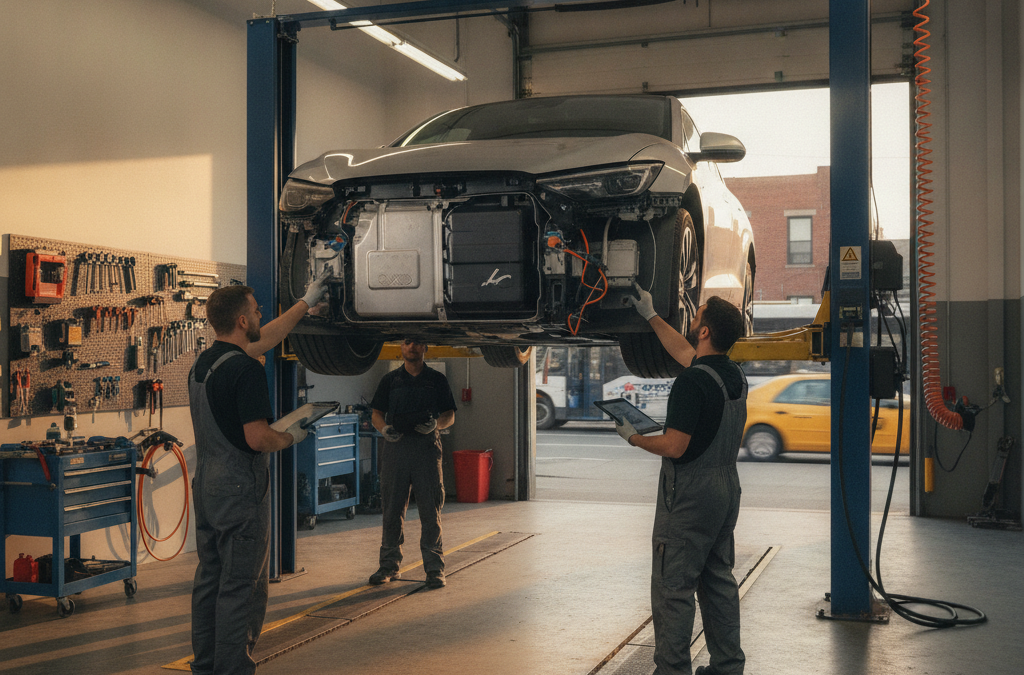
What Bronx and Kingsbridge Drivers Should Know About Getting a Car Repaired When the Damage Involves Your EV’s Battery or Charging System
If your electric vehicle was involved in a collision — even one that looked minor from the outside — and you’re worried about what it did to the battery pack or charging system underneath, that’s a smart concern to have. EV collision repair is genuinely different from conventional auto body work, and the honest truth is that the vast majority of body shops in the Bronx, including many that will happily take your keys, are not set up to handle it safely or correctly. At S&T Auto Body, we work with EV owners across Kingsbridge, Riverdale, and throughout the borough every week, and we want to give you a straight answer about what’s actually at stake when your EV takes a hit.
Why EV Battery and Charging Damage Is Different from a Regular Collision
In a conventional gas-powered vehicle, a collision might crack a bumper, bend a frame rail, or damage a fuel line — serious problems, but ones that most trained technicians understand well. In an electric vehicle, there’s an entirely different layer of concern sitting right below the floor of the car: a large-format battery pack, often weighing 1,000 pounds or more, that runs the full length of the vehicle’s undercarriage. In a Tesla Model 3, Model Y, or Model S, that battery is structural. It’s not just a power source — it’s part of what holds the car together.
When that battery takes impact damage, a few things can happen that you won’t see from the outside. The cells inside the pack can be punctured or deformed. The battery management system — the electronics that regulate charging and discharge — can be disrupted. Coolant lines that run through the pack to keep it at temperature can leak. And in a worst-case scenario, damaged lithium-ion cells can enter a state called thermal runaway, which can lead to a fire hours or even days after the initial collision. That’s not meant to frighten you — it’s meant to explain why this kind of damage requires a shop that actually knows what it’s dealing with.
What a Certified EV Shop Does That a Generic Body Shop Doesn’t
This is where the gap between shops becomes very real, and it’s an area where most competitors in this market don’t give drivers nearly enough information. Here’s what a properly equipped, certified EV repair facility actually does differently:
- High-voltage system isolation before any work begins. Before a technician so much as touches the underside of a damaged EV, the high-voltage system — which runs at 400 volts or higher — must be properly shut down and isolated using manufacturer-approved procedures. This isn’t optional and it isn’t something you improvise. Technicians need specific training and equipment to do this safely.
- Battery inspection and diagnostic scanning. A visual check isn’t enough. Certified EV technicians connect to the vehicle’s onboard systems to read fault codes, check cell voltage balance, and identify any internal damage the battery management system has logged — including impact events the car recorded automatically.
- Aluminum body repair expertise. Most EVs, and Teslas in particular, use aluminum-intensive body structures rather than traditional steel. Aluminum repairs require different welding techniques, different tools, and dedicated workspace to prevent cross-contamination with steel — which can actually cause corrosion in aluminum panels if handled carelessly.
- Charging port and onboard charger inspection. If the vehicle was hit in certain areas, the charging port assembly, the onboard charger module, or the DC fast-charging hardware can be damaged — sometimes in ways that don’t show up until the next time you try to plug in.
At S&T Auto Body, our technicians are trained to handle all of this. We’re a Tesla-certified collision repair facility, which means Tesla has evaluated our facility, our equipment, and our training and approved us to repair their vehicles to factory standards. That certification isn’t handed out easily, and it matters when your vehicle’s repair has to meet the same safety and structural standards it left the factory with.
What This Means for Your Insurance Claim
EV battery and charging system repairs can be expensive — that’s the honest answer. Depending on the severity of the impact and what diagnostic scanning reveals, you could be looking at repairs that range from a straightforward charging port replacement to a full battery pack replacement, which is among the most significant repairs possible on any electric vehicle. Your insurer — whether that’s Geico, a regional carrier, or anyone else — needs to receive a complete, itemized estimate that accounts for everything the certified repair actually requires.
One of the most common problems we see is EV owners who take their vehicle to a shop that writes a surface-level estimate, misses the battery or charging damage entirely, and submits a claim that doesn’t cover the full scope of repair. That puts you in a difficult position: you’ve accepted a settlement or approved a repair, and weeks later you find out the car isn’t charging correctly or a warning light won’t clear. Getting it right the first time — with an itemized, diagnostic-backed estimate from a certified shop — protects you throughout the claim process.
We work directly with Geico and other major insurers as a preferred repair facility, and we know how to document EV-specific damage in a way that holds up and gets your claim handled correctly. If you have questions about the process before you even bring the vehicle in, we can walk you through it.
Drivers in Kingsbridge, Riverdale, and Across the Bronx Are Buying EVs Fast — and Most Shops Aren’t Ready
EV adoption across the New York City metro has accelerated significantly over the past few years, and the Bronx is no exception. In neighborhoods like Kingsbridge and Riverdale, and across the county line into Yonkers and Westchester County, more drivers are behind the wheel of a Tesla, a Hyundai Ioniq, or another battery-electric vehicle than ever before. But the collision repair infrastructure hasn’t fully caught up. Most shops that have been repairing conventional vehicles for decades haven’t made the investment in EV-specific training, equipment, or manufacturer certifications.
That’s not a criticism — it’s just the reality of where the industry is. But it means that if your EV is damaged, you need to ask the right question before you tow it anywhere: Are you actually certified to repair this vehicle? Not just willing to try. Certified. There’s a real difference, and your safety — and your warranty — depend on it. You can review our full list of manufacturer certifications to see exactly what we’re approved to repair.
We’ve been serving Bronx drivers since 1975. We’ve seen every phase of the auto industry change over five decades, and we’ve invested in staying ahead of those changes — including the shift to electric vehicles — because our customers deserve a shop that’s actually equipped to take care of them. If you drive in from Manhattan or across the border from Westchester County, we’re ready for your EV just the same.
Frequently Asked Questions
Can I drive my EV home after a collision if it seems to be running fine?
It depends on the severity of the impact, but we’d encourage caution. Even if the car drives normally immediately after a collision, damaged battery cells can degrade over hours. If the hit was anything more than a very minor tap, have the vehicle inspected by a certified EV shop before leaving it unattended or charging it overnight.
Will my insurance cover EV battery replacement after a collision?
If the battery damage is directly caused by the collision, it should be covered under your collision coverage — but it needs to be properly documented in the estimate. This is another reason to use a certified shop that knows how to diagnose and report EV-specific damage correctly. A generic shop may miss it entirely.
Does getting my Tesla repaired at a non-Tesla-certified shop void my warranty?
It can, especially for battery and powertrain-related components. Tesla’s warranty terms require that repairs be performed using approved methods and parts. Using an uncertified shop for structural or battery-adjacent repairs may give Tesla grounds to deny future warranty claims related to those systems.
How long does EV collision repair typically take compared to a regular car?
It varies significantly depending on what’s damaged. Body panel work on an EV takes similar time to conventional repairs, but if battery diagnostic work, module replacement, or software recalibration is needed, the timeline can be longer. We’ll give you a realistic estimate upfront so you’re not caught off guard.
Do you handle EV repairs for vehicles other than Tesla?
Yes. While Tesla is one of our specific certifications, we repair a wide range of electric and hybrid vehicles. If you’re driving a Hyundai Ioniq, a Kia EV6, a Volkswagen ID.4, or another EV, reach out and we’ll let you know exactly what we can do for your vehicle.
Get a Free Estimate Before You Commit to Anything
If your EV was in a collision and you’re not sure where to take it, start with a conversation. You can contact S&T Auto Body to request a free, no-obligation estimate — submit photos and your vehicle information and we’ll give you a clear picture of what the repair involves before you make any decisions. We’re a family-owned shop with five decades of experience serving the Bronx, and we’ll give you a straight answer every time. Call us at (718) 220-2201 or reach out online. We’re here to help you get back on the road safely.