What Bronx and Queens Drivers Should Know About Getting a Car Repaired When Your Vehicle Has Advanced Driver Assistance Systems (ADAS)
Yes, your car’s safety systems need to be recalibrated after a collision — even if the damage looks minor. If your vehicle has features like automatic emergency braking, lane-keeping assist, adaptive cruise control, or blind spot monitoring, those systems rely on cameras and sensors built into your bumpers, windshield, mirrors, and grille. The moment any of those areas take an impact — even a parking lot fender-bender on the way home from Fordham Road — there’s a real chance one or more of those sensors is now slightly off. And slightly off is enough to make the system fail you when you actually need it.
This is one of the most underexplained parts of collision repair right now, and it’s something Bronx and Queens drivers especially need to understand. With dense traffic, tight streets, and the constant stop-and-go around the Cross Bronx Expressway and the BQE, many local drivers depend on these systems every single day. Getting the bodywork fixed without addressing ADAS calibration is like patching a tire but leaving the valve stem loose.
What ADAS Actually Is — and Why It’s More Fragile Than It Looks
ADAS stands for Advanced Driver Assistance Systems. It’s the umbrella term for the collection of electronic safety features that have become standard on most new vehicles sold in the last five to ten years. You probably know them by their individual names: forward collision warning, automatic emergency braking (AEB), lane departure warning, blind spot detection, rear cross-traffic alert, parking sensors, and backup cameras.
Each of these features depends on one or more physical components — cameras, radar units, ultrasonic sensors, or LIDAR — that are mounted in very specific locations on your vehicle. The front bumper cover typically houses radar sensors for AEB and adaptive cruise control. The windshield often has a forward-facing camera for lane-keeping. Your side mirrors may contain blind spot radar. The rear bumper has sensors and cameras for parking assist.
Here’s the catch: all of these components are calibrated to precise angles and positions at the factory. When your bumper gets pushed in — even a few millimeters — or your windshield gets replaced after a crack from road debris, those angles can shift. The system doesn’t know it’s off. It keeps running. But now it might not warn you in time, or it might activate when it shouldn’t. That’s not a minor inconvenience. That’s a safety issue.
The Two Types of ADAS Calibration: Static and Dynamic
There are two ways ADAS systems get recalibrated after a repair, and not every shop can do both. Understanding the difference helps you ask the right questions.
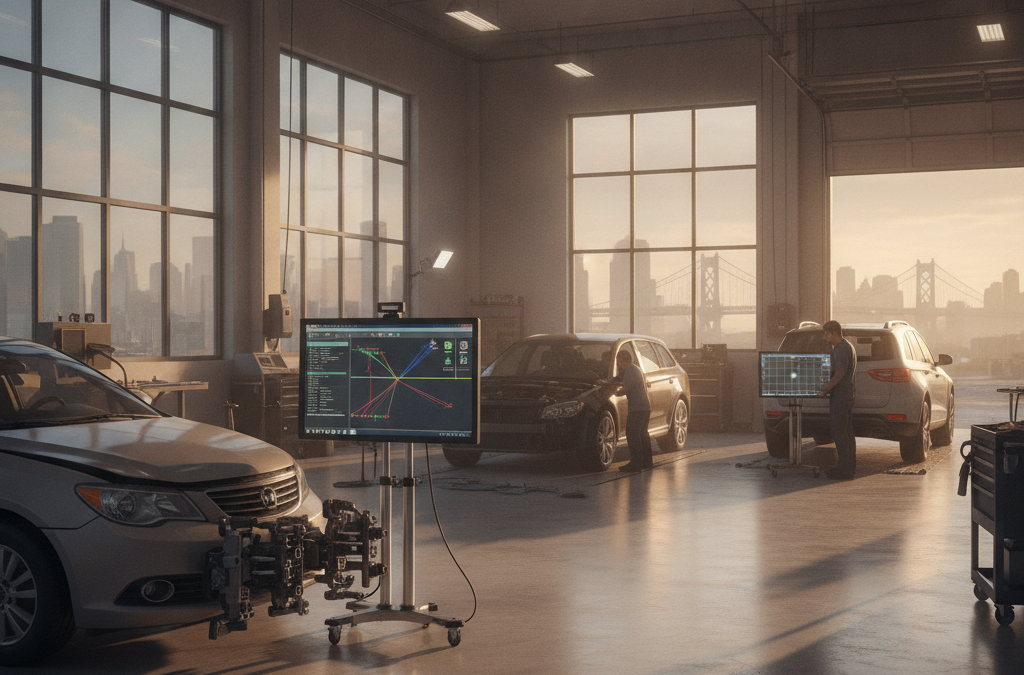
Static calibration is done in the shop, with your vehicle parked in a controlled environment. Technicians use specialized targets — think large printed patterns or reflective boards — placed at exact distances and angles in front of or beside the vehicle. The calibration equipment communicates with your car’s computer and adjusts the camera or sensor readings to the correct baseline. This process requires a flat, level surface, enough space, and the right manufacturer-specific tools. A general repair shop that doesn’t have this setup cannot do this correctly.
Dynamic calibration is done while driving. A technician drives the vehicle on an open road at a set speed so the system can recalibrate itself using real-world data — lane markings, other vehicles, and so on. Some vehicles require both types, one after the other. Which type your car needs depends on the make, model, and which systems were affected.
At S&T Auto Body, our manufacturer-certified technicians are trained on the specific ADAS calibration requirements for each brand we work on. That includes everything from domestic vehicles to European makes to EVs with their own unique sensor configurations.
Why This Matters More in NYC Than Almost Anywhere Else
Drivers in the Bronx, Queens, Manhattan, and Westchester put more daily miles on their ADAS systems than almost anyone else in the country. Stop-and-go traffic on the Major Deegan, parallel parking on narrow Morris Park side streets, merging onto congested expressways — these are exactly the situations where your automatic braking and blind spot alerts are working hardest.
NYC also has one of the highest rates of minor collisions in the country. Scrapes, sideswipes, and rear-end taps happen constantly. And because a lot of those accidents look cosmetic — a scuffed bumper, a cracked fascia — drivers and even some shops will focus only on the visible damage and skip the sensor check entirely. That’s a mistake.
It’s also worth knowing that if you’re filing an insurance claim, your insurer may not automatically authorize ADAS recalibration unless your shop identifies the need and documents it clearly. An experienced shop will flag this in your estimate and communicate it to the adjuster. A shop that doesn’t understand ADAS may not even look for it.
What a Lot of Local Shops Are Getting Wrong
This is where we need to be honest with you. ADAS calibration is a relatively new requirement in the collision repair industry, and not every shop has caught up. Many smaller shops — and even some mid-size operations — don’t have the equipment, the training, or the manufacturer-specific software to do this correctly.
Some will claim they “checked the sensors” without actually running a proper calibration procedure. Others will fix the physical damage and hand the car back assuming everything is fine. And a few will acknowledge the issue but send the car somewhere else for calibration as an afterthought, without coordinating it properly as part of the repair process.
When you’re looking for a shop, ask directly: Do you perform ADAS calibration in-house? What equipment do you use? Do your technicians have manufacturer-specific training for my vehicle’s systems? If the answer is vague, that’s your signal to keep looking.
Our I-CAR Gold Class certified team at S&T Auto Body stays current on ADAS repair and calibration procedures as part of ongoing required training. I-CAR Gold Class isn’t just a plaque on the wall — it means our technicians are completing updated courses every year as vehicles and their systems evolve. You can learn more about what that means for your repair on our about page.
Which Repairs Are Most Likely to Require ADAS Recalibration
Not every repair triggers an ADAS recalibration need, but many common ones do. Here’s a quick reference:
- Front bumper repair or replacement — Radar sensors for AEB and adaptive cruise control are almost always housed here
- Rear bumper repair or replacement — Parking sensors and rear cross-traffic alert systems are affected
- Windshield replacement — Forward-facing cameras mounted at the rearview mirror base require recalibration after any glass work
- Side mirror replacement — Blind spot detection radar is often embedded in or near the mirror housing
- Front or rear alignment work — Sensor angles are based on a correctly aligned vehicle; alignment changes affect calibration
- Hood or grille panel replacement — Some forward-facing sensors are mounted behind the grille
If your repair involves any of these areas, assume ADAS calibration is part of the job. A thorough shop will confirm this during the estimate process and include it in the written scope of work.
Does Insurance Cover ADAS Calibration?
Generally, yes — if the calibration is required as a direct result of the collision damage being repaired, it should be covered under your collision or comprehensive claim. The key is documentation. Your shop needs to clearly note in the estimate which systems were affected, what calibration is required, and why. Major insurers operating in the New York metro area, including Geico, have become more familiar with ADAS calibration costs as the technology has become more widespread. A shop that does this regularly will know how to document and communicate it correctly. One that doesn’t may leave that line item off entirely, meaning you either pay out of pocket or drive away with systems that were never properly checked.
If you’re working through a claim and have questions about what should and shouldn’t be covered, our team can walk you through it. We’ve helped hundreds of drivers across the Bronx and surrounding areas navigate exactly this kind of situation. You can get started by visiting our collision repair services page or reaching out directly for a free estimate.
Frequently Asked Questions
How do I know if my car has ADAS?
If your car was manufactured in the last six to eight years and has any of the following — automatic emergency braking, lane departure warning, blind spot detection, adaptive cruise control, or parking assist — it has ADAS. Check your owner’s manual or the window sticker from when you purchased the vehicle. If you’re not sure, our team can confirm during your estimate appointment.
Can I drive my car if I think the ADAS sensors are off after a collision?
Yes, your car will still drive. But you should not rely on those safety systems until they’ve been checked and recalibrated. A warning light on your dashboard after an accident is a clear sign something needs attention. Even without a warning light, any impact to areas where sensors are mounted warrants an inspection.
Does ADAS calibration take a long time?
Static calibration can take anywhere from one to three hours depending on the vehicle and the number of systems affected. Dynamic calibration requires a road test. Most shops schedule this as part of the overall repair timeline rather than a separate trip. It shouldn’t add days to your repair — but it does need to be planned for.
I just need a bumper replaced. Do I really need calibration too?
In most cases, yes — if your vehicle has front radar sensors or cameras mounted on or near the bumper. Even a brand-new replacement bumper positioned slightly differently than the original can affect sensor readings. Your shop should verify this during the estimate, not after the repair is complete.
Will a non-certified shop be able to calibrate my ADAS?
Some general shops have purchased aftermarket calibration tools that work for a range of vehicles. However, for manufacturer-specific calibration requirements — especially on newer vehicles, EVs, or luxury brands — you want a shop with actual OEM training and certified procedures. The calibration procedure for a Ford F-150 is not the same as for a Mercedes or a Tesla. A shop that is certified to repair your specific make is the safest choice.
Get It Done Right the First Time
We’ve been taking care of Bronx drivers and their families since 1975. In fifty years, the cars have changed a lot — but our commitment to doing the job completely and correctly hasn’t. ADAS calibration is just the newest chapter in that story. Whether you’re coming in from Queens, Westchester County, or right down the road in Morris Park or Fordham, we’ll make sure every system on your vehicle is working the way it was designed to before you drive it home.
If you’ve been in a collision and your vehicle has any kind of driver assistance technology, don’t assume the shop you choose knows how to handle it. Ask the question. We’ll give you a straight answer. Contact S&T Auto Body at (718) 220-2201, email us at info@stautobody.com, or request your free estimate online. We’re here to help you get back on the road safely — not just back on the road.