What Bronx and White Plains Drivers Should Know About Getting a Frame Straightening Job Done Right After a Collision
If your car was in a serious collision and someone mentioned the word “frame,” it’s natural to feel your stomach drop a little. Frame damage sounds severe — and it can be — but it doesn’t automatically mean your vehicle is a total loss or that it can’t be safely repaired. What it does mean is that the work has to be done correctly, by technicians who actually know what they’re doing, using the right equipment and the right measurements. For drivers in the Bronx, White Plains, and the surrounding area, here’s what you need to understand before you approve a single dollar of frame or structural repair.
What Does “Frame Damage” Actually Mean on a Modern Car?
Most vehicles built in the last 30 years don’t have a traditional ladder frame the way an old pickup truck does. Instead, they use a unibody design — the body and the structural components are all welded together as one unit. When that structure gets bent, twisted, or compressed in a collision, that’s still commonly called “frame damage,” but the technical term is structural or unibody damage.
Here’s why that distinction matters: repairing unibody damage isn’t just about pulling the metal back to where it looks right. It’s about restoring the vehicle’s structural integrity to factory specifications — the exact measurements the manufacturer engineered into the car for crash protection. A vehicle that’s a quarter-inch out of alignment might look fine from the outside, wear tires unevenly on the inside, and fail to protect you the way it should in the next accident.
On the Cross Bronx Expressway, the Major Deegan, or anywhere in the dense stop-and-go traffic of the NYC metro area, you need your car’s structure working the way it was built to work.
How Do Shops Actually Diagnose and Repair Frame Damage?
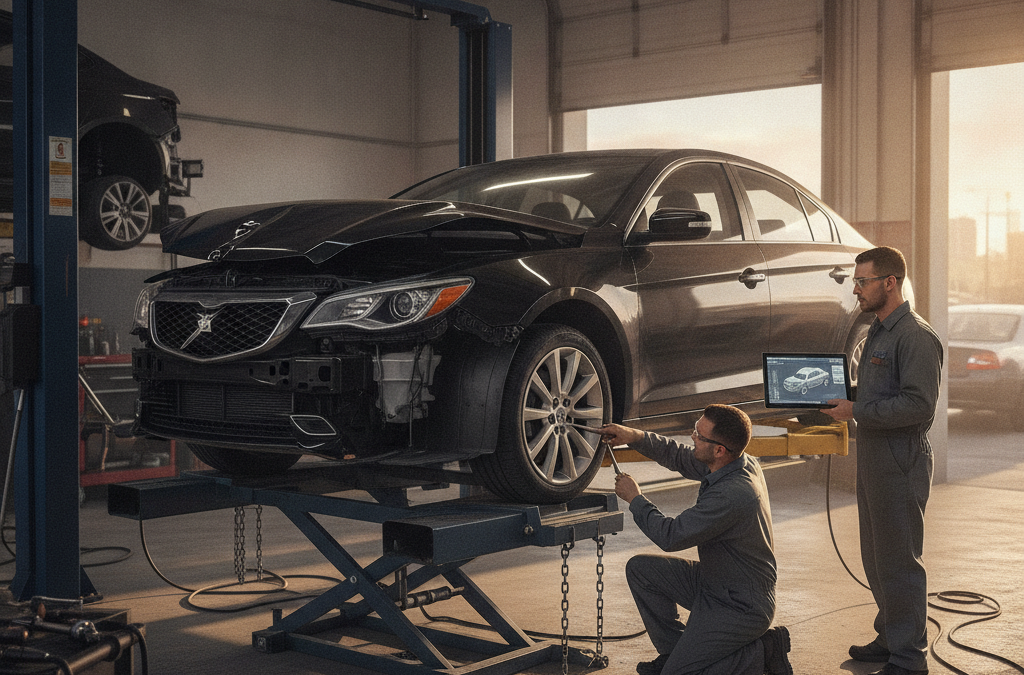
A qualified shop uses a computerized measuring system — sometimes called a frame machine or bench — to take precise three-dimensional measurements of your vehicle’s structural points and compare them against the manufacturer’s published specifications. This is not guesswork. It’s data.
Once the extent of the damage is mapped out, technicians use hydraulic equipment to pull the structure back into alignment, applying force at precise points and angles. At S&T Auto Body, our I-CAR Gold Class certified technicians are trained specifically in this process — including how different metals and modern high-strength steels behave under stress and during repair.
Why does that training matter? Because modern vehicles use advanced high-strength steel and aluminum in their structures — materials that can’t simply be heated and hammered back into shape the way older mild steel could be. Try to repair them incorrectly and you can actually weaken the metal further, creating a vehicle that looks straight but is compromised where it counts most.
What Competitors in the Area Often Don’t Tell You
Here’s something most body shop websites — including several in the Bronx and Westchester area — don’t explain clearly: not every shop that claims to do frame work has the equipment or training to do it properly. Some shops have older or generic measuring systems that don’t pull the precise factory data for your specific vehicle. Others may straighten the frame well enough for the car to drive straight but never verify the final measurements against OEM specs before closing the job out.
When you’re asking a shop about frame repair, the questions to ask are simple but direct:
- What computerized measuring system do you use, and does it pull factory specifications for my exact vehicle?
- Will you provide me with a before-and-after measurement report?
- Are your technicians I-CAR trained in structural repair?
- Will any sectioning or welding be done, and how will that be documented?
A shop that can answer all four of those questions clearly — with documentation — is a shop that takes structural repair seriously. One that gets vague or defensive is a shop to walk away from.
Frame Repair, Insurance, and What to Watch Out For
Frame and structural damage repairs are generally covered under your collision insurance — but the claims process for this type of work has a few wrinkles worth knowing about. First, the initial estimate your insurance company provides may not account for all the damage. Structural issues sometimes reveal themselves only after disassembly, and a shop that finds additional damage mid-repair has to go back to the insurer for a supplement. This is normal. A good shop handles this communication for you.
Second, some insurers — especially through direct repair programs — may try to steer you toward faster, cheaper repair methods that don’t meet the manufacturer’s repair procedures. You have the right to insist on OEM-compliant repair methods, and a certified shop will back you up on that. Our collision repair team works directly with Geico and other major insurers and knows how to document structural work properly so there are no surprises when the job is done.
Drivers coming to us from White Plains, Yonkers, and other parts of Westchester County often tell us they went to a closer shop first, had questions about how the structural work was done, and then came to us to have the vehicle properly measured and rechecked. That’s a situation nobody wants to be in. It’s worth getting it right the first time.
When the Car Is Near the Line Between Repairable and Totaled
Not every vehicle with frame damage is worth repairing. If the structural damage is severe enough — or if the cost to restore it to factory spec approaches or exceeds the vehicle’s actual cash value — your insurer may declare it a total loss. That’s not necessarily bad news; it means you get a settlement to replace the vehicle rather than ride in something that was never fully fixed.
The key is having a shop with the expertise to give you an honest assessment upfront. If we think a vehicle is going to be a borderline total once the full extent of damage is known, we’ll tell you that before work begins — not halfway through the job. That’s been our approach since we opened our doors in the Bronx in 1975, and it’s not changing now.
If you drive a Mercedes-Benz, Tesla, or another manufacturer-certified vehicle, structural repair has additional layers — because those manufacturers have specific approved repair procedures, and deviation from them can affect your warranty. Learn more about what that means on our certified repair page.
Frequently Asked Questions
Can a car with frame damage be safely driven afterward?
Yes — if the structural repair was done correctly and verified against factory specifications using a computerized measuring system. A properly repaired unibody vehicle can be just as safe as it was before the accident. The key word is “properly.” An incomplete or unchecked repair is a different story.
How long does frame straightening typically take?
Structural repair alone can take anywhere from a day to several days depending on severity. When combined with body panel replacement, paint, and reassembly, most moderate-to-severe collision repairs that include frame work take one to three weeks. We’ll give you a realistic timeline upfront — not one designed to get you to approve the job.
Will frame damage show up on a Carfax report?
Typically yes, if the damage was reported to an insurer or documented at a repair shop. This is one reason some drivers are anxious about frame damage — it can affect resale value. That’s a real concern, but it’s separate from whether the vehicle is safely repaired. Both things can be true: the car is safe to drive and its history has been disclosed.
Do I have to go to the shop my insurance company recommends for frame repair?
No. In New York State, you have the right to choose your own repair shop. Your insurer cannot legally require you to use a specific facility, and they must work with the shop you choose. Some insurers make their preferred shops sound mandatory — they are not.
What if I live in Manhattan or Westchester — is it worth coming to the Bronx for this kind of repair?
Drivers from Manhattan, White Plains, Yonkers, and across Westchester County come to us specifically because they want certified structural repair from technicians they can trust. Our location on 3rd Avenue in the Bronx is accessible, and for a job this important, the drive is worth it.
Get an Honest Assessment Before You Commit to Anything
Frame damage is not something to guess about or hand off to whoever is closest or cheapest. It’s the structure that keeps you and your passengers safe. At S&T Auto Body, we’ve been doing this work in the Bronx for 50 years. We use computerized measuring equipment, employ I-CAR Gold Class trained technicians, and document our structural repairs so you — and your insurer — know exactly what was done.
If your car took a serious hit and you’re not sure what you’re dealing with, don’t wait. Request a free estimate and let us take a look before you make any decisions. Contact S&T Auto Body here — we’ll tell you what we see, straight up, with no pressure.