What Bronx and Yonkers Drivers Should Know About Getting a Car Repaired When the Accident Involved a Commercial Vehicle or Delivery Truck
If you were hit by a delivery truck, a box van, or any other commercial vehicle in the Bronx or Yonkers, you already know it felt different from a typical two-car fender-bender. The damage is often worse, the other party’s insurance situation is more complicated, and the pressure to settle quickly can be intense. Before you sign anything, agree to a repair shop, or accept a check, there are a few things you really need to understand.
Why Commercial Vehicle Accidents Are Different From Regular Collisions
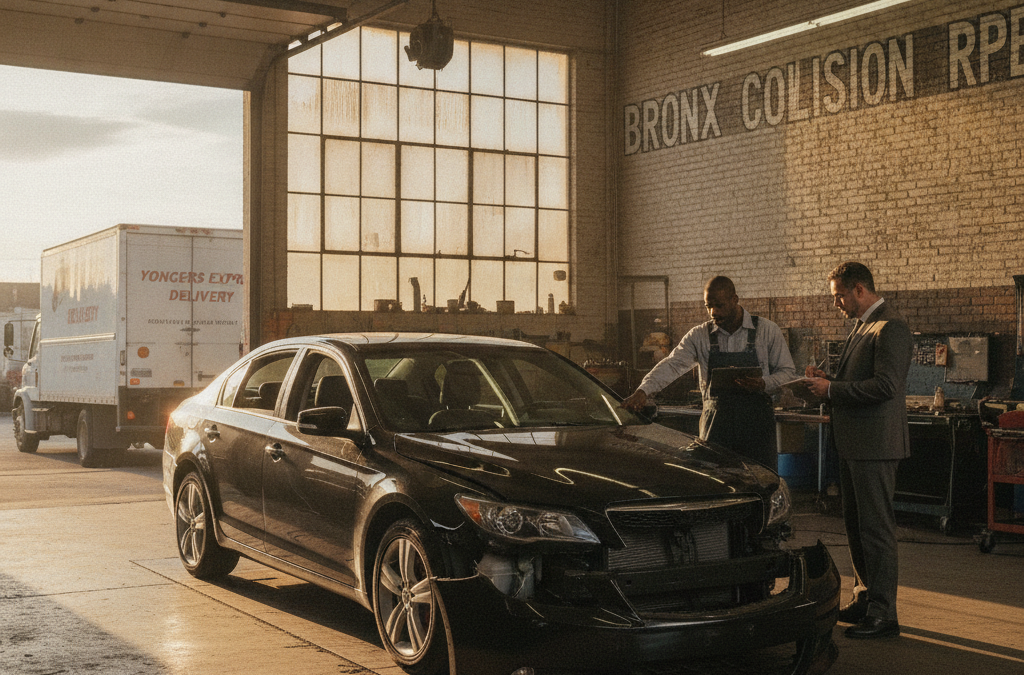
Delivery trucks, box vans, and commercial vehicles are heavier, ride higher, and hit harder than a passenger car. When one clips you on the Cross Bronx Expressway or rear-ends you on a surface street in Yonkers, the damage to your vehicle is often more extensive than it looks on the surface. The front clip, hood, radiator support, and frame can absorb a tremendous amount of force — and cosmetic damage to the bumper or quarter panel is frequently the least of your problems.
What makes these accidents uniquely complicated isn’t just the physics. It’s what happens afterward. The commercial driver isn’t just some other person with a State Farm policy. They’re an employee — or a contractor — of a company, and that company has a corporate insurance carrier and, often, an in-house claims team whose job is to close your claim as cheaply and quickly as possible. That’s a very different dynamic than dealing with another individual driver’s insurer.
Don’t Let the Other Driver’s Insurance Steer You to Their Preferred Shop
One of the most common things that happens after a commercial vehicle accident is that the at-fault carrier — whether it’s a large delivery company’s insurer or a smaller fleet operator — will push you toward a specific repair shop or a network of “approved” shops. They may make it sound like you’re required to use that shop. You are not.
In New York State, you have the legal right to choose your own repair facility. Full stop. If the other driver is at fault and their company’s insurance is handling the claim, they still cannot force you to use a shop you didn’t choose. What they can do is pressure you, make the process feel slower if you don’t comply, and hope you just go along with it.
The shop a corporate insurer directs you to is chosen for the insurer’s convenience and cost savings — not yours. That shop may use aftermarket or non-OEM parts, may not hold the manufacturer certifications your vehicle requires, and may not have the experience to properly assess damage from a heavy commercial impact. Manufacturer certifications matter, especially when the collision was severe.
Hidden and Structural Damage Is More Common in These Accidents
When a commercial vehicle hits a passenger car, the force doesn’t always go where you’d expect. Because trucks sit higher, impact energy often transfers downward and inward — which means frame rails, subframe components, and even suspension geometry can be compromised in ways that don’t show up in a quick visual inspection or a low-ball estimate from an adjuster who spent ten minutes looking at your car in a parking lot.
At S&T Auto Body, we’ve been doing this work in the Bronx since 1975. We use computerized frame measuring equipment to check whether your vehicle’s structural geometry is within manufacturer specifications — not just whether it looks straight. If you bring your car to us after a commercial vehicle accident, we’re going to take the time to find everything before we write the estimate, not discover it halfway through the repair.
That thoroughness matters for your safety. It also matters for your insurance claim. A fully documented, itemized estimate from a certified shop carries a lot more weight with an insurer than a quick visual once-over. Learn more about how we approach collision and structural repair here.
What the Insurance Process Actually Looks Like
If the commercial driver was clearly at fault, their employer’s insurance carrier should be covering the repair. But “should be” and “is” aren’t always the same thing, especially in the early days after an accident.
Here’s what typically happens and where things can go sideways:
- The adjuster inspects your vehicle — often quickly, often without the kind of disassembly needed to find hidden damage. Their initial estimate may be significantly lower than the actual repair cost.
- They offer a quick settlement — commercial carriers often move fast on smaller claims, hoping you’ll accept before you understand the full scope of damage.
- Supplement negotiations begin — if you’ve chosen a reputable shop, they’ll document additional damage found during disassembly and submit supplements to the insurer. This is normal and expected.
- The shop gets paid directly — in most cases, a certified shop like ours handles the billing directly with the insurer, so you’re not writing checks and waiting to be reimbursed.
We work with Geico and all major insurers. If the at-fault driver’s commercial carrier is handling the claim, we know how to navigate that process and document repairs to meet their requirements. You shouldn’t have to figure this out on your own while you’re already stressed about getting back on the road.
What Drivers in Yonkers and Mount Vernon Should Know About Commercial Traffic on Local Roads
If you’re driving regularly in Yonkers, Mount Vernon, or along the major commercial corridors connecting Westchester County to the Bronx, you’re sharing the road with a high volume of delivery and commercial vehicles. The last-mile delivery surge hasn’t slowed down, and the number of large vans and trucks operating in dense residential and commercial zones has grown significantly in recent years.
That means more exposure to exactly the kind of accident we’re describing. It also means local body shops see these cases regularly — and there’s a meaningful difference between a shop that knows how to handle them and one that doesn’t. At S&T Auto Body, our I-CAR Gold Class certified technicians are trained specifically on the kinds of structural and collision repair scenarios that come with high-force impacts from larger vehicles.
Should You File Through Your Own Insurance or the At-Fault Party’s?
This is one of the most common questions we hear, and the honest answer is: it depends on your specific situation, your deductible, and how cooperative the at-fault carrier is being.
If the fault is clear and the commercial carrier is accepting liability, filing directly through their insurance typically avoids you having to pay your deductible out of pocket. However, if the other carrier is dragging their feet, disputing liability, or pushing a lowball estimate, some drivers choose to file through their own collision coverage first to get the car fixed quickly, then let their insurer pursue the commercial carrier for reimbursement — a process called subrogation.
We can help you think through the options based on what we’re seeing with your specific damage and claim. We’re not attorneys and we’re not adjusters, but we’ve been helping Bronx drivers navigate this for fifty years, and we know what tends to work.
Frequently Asked Questions
Can a commercial carrier’s insurer require me to use a specific shop?
No. In New York, you have the right to choose your own repair shop regardless of which insurance carrier is paying. Don’t let anyone tell you otherwise.
What if the delivery driver says the accident was my fault?
Get everything documented at the scene — photos, the driver’s information, the company name on the vehicle, and a police report number if one was filed. Don’t settle anything informally. Let the insurers investigate. We can help you get a free, itemized estimate that documents the damage clearly, which is useful no matter how liability eventually gets assigned.
How long does it take to repair a car that was hit by a commercial vehicle?
It depends on the extent of the damage. Structural repairs, frame straightening, and parts procurement — especially for newer vehicles that require OEM components — can take longer than a simple panel repair. We’ll give you an honest timeline upfront, not an optimistic guess.
Does S&T Auto Body handle the insurance billing, or do I have to pay and get reimbursed?
We handle billing directly with insurers in most cases. You shouldn’t be fronting money for repairs that are covered. We’ll walk you through exactly how payment will work before any work begins.
What if more damage is found after the repair starts?
This is common, especially in commercial vehicle accidents. We document any additional damage found during disassembly and submit a supplement to the insurer. We contact you before proceeding with anything beyond the original scope. No surprises.
Get a Free Estimate Before You Commit to Anything
If you’ve been in an accident involving a commercial vehicle or delivery truck in the Bronx, Yonkers, or anywhere in the surrounding area, the smartest first step you can take is getting an independent, itemized estimate from a certified shop — before you agree to anything the other carrier is offering.
S&T Auto Body has been serving the Bronx and the broader New York City metro since 1975. We’re family-owned, we’re I-CAR Gold Class certified, and we hold manufacturer certifications that matter when your vehicle needs to be repaired to spec. We’ll give you a straight answer about what your car needs and work with your insurer — or the at-fault carrier — to get it done right.
Contact us to request your free estimate or call us directly at (718) 220-2201. You’ve already dealt with enough — let us take it from here.