What Bronx and Manhasset Drivers Should Know About Getting a Car Repaired When You Want to Know If the Shop Is Actually Certified
If a shop has a few logos on its website and a sign in the window, that does not automatically mean it’s certified — not in the way that actually protects you. In the Bronx and across the metro area, including drivers coming in from Manhasset, Westchester County, and Nassau County, this is one of the most misunderstood things about choosing a collision repair shop. A shop can display a manufacturer’s logo without holding a current, active certification. And if you don’t know the difference, you could end up with repairs that void your warranty, get denied by your insurance company, or — more seriously — leave structural or safety systems improperly restored. Here’s how to actually check, and what to ask before you trust anyone with your vehicle.
Why “Certified” Is a Word That Gets Thrown Around Too Loosely
Walk down any block near Fordham Road or the Grand Concourse and you’ll see body shops with all kinds of signage. Some of those shops have earned real manufacturer certifications through rigorous programs that require specific equipment, trained technicians, and ongoing audits. Others have simply printed a logo they once qualified for — or never actually did.
Manufacturer certification programs — like those run by Tesla, Mercedes-Benz, Ford, Subaru, Hyundai, and others — are not lifetime awards. They require shops to maintain approved equipment, use OEM parts, keep their technicians trained to current standards, and submit to periodic reviews. If a shop lets its certification lapse, or never had it at all, you as the customer have no way of knowing unless you look it up yourself.
This is a gap that most competitor shop websites never address directly. They list certifications on their pages, but they don’t tell you how to verify those claims or what questions to ask. We think that’s a problem, so let’s fix it.
How to Actually Verify a Shop’s Certifications
The good news: most major manufacturers make their certification look-up tools available to the public. Here’s where to go:
- Tesla: Use the Tesla-approved body shop locator on Tesla’s website. Only shops that have completed Tesla’s Body Repair Program and maintain current standing will appear there. If the shop doesn’t show up, they’re not certified — regardless of what they tell you.
- Mercedes-Benz: Mercedes maintains a Certified Collision Center directory. You can search by zip code. Certified shops must meet strict standards for equipment, training, and OEM parts usage — and they’re subject to audits.
- Ford, GM, Subaru, Hyundai, Volkswagen, Toyota, Lexus, and others: Most major manufacturers have similar online locators. Search “[Manufacturer] certified collision center near me” and use the official brand website — not a third-party listing — to verify.
- I-CAR Gold Class: I-CAR maintains a public database at i-car.com where you can confirm whether a shop holds Gold Class status. This is the industry’s leading technician training standard, and it covers repair quality and safety practices across all makes and models.
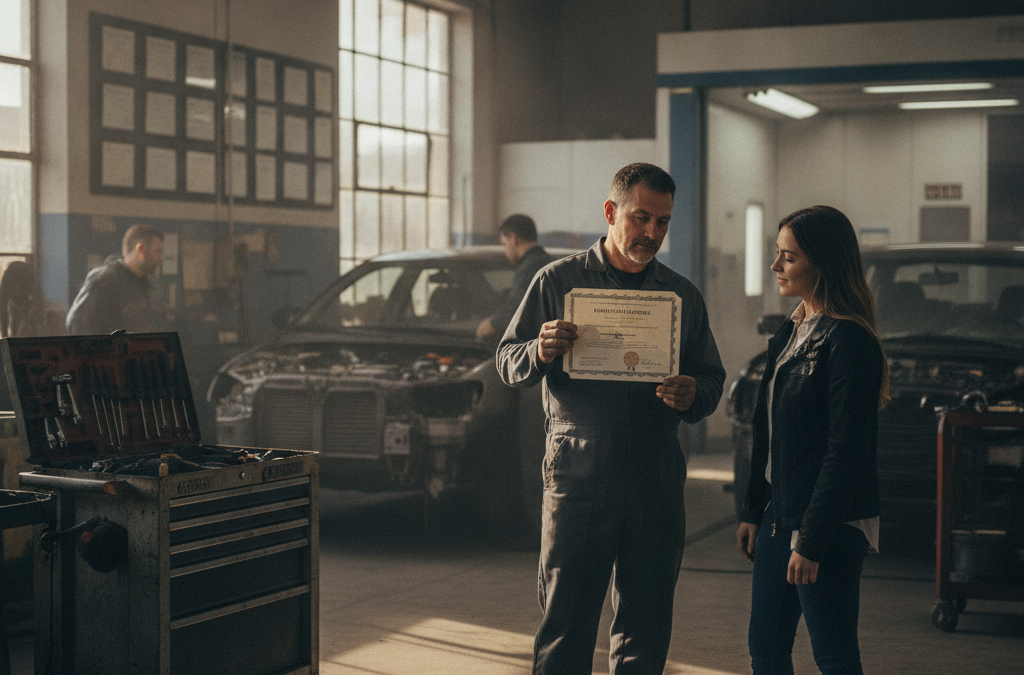
If a shop claims to be certified and doesn’t appear in any of those official directories, that’s your answer. Ask the shop directly: “Can you show me your current certification documents?” A legitimate shop will not hesitate.
What These Certifications Actually Mean for Your Repair
Certifications are not just marketing badges. They exist because modern vehicles — especially EVs, luxury cars, and vehicles with advanced safety systems — are engineered to extremely precise tolerances. A door panel that’s welded one millimeter off. A sensor recalibrated with generic tools instead of OEM equipment. A high-voltage battery system worked on by a technician who hasn’t completed EV-specific training. Any of these things can affect how your vehicle performs in a future collision — or how your airbags deploy.
For drivers in Manhasset or White Plains bringing in a Mercedes GLE or a Tesla Model Y after a highway accident, the stakes are real. Manufacturer-certified repair ensures that your vehicle is restored to the spec it left the factory with — not just to a standard that looks right from the outside.
Beyond safety, there are two practical concerns that affect you financially:
- Warranty implications: If your vehicle is under a manufacturer warranty and it’s repaired by a non-certified shop using non-OEM parts, that repair may affect your warranty coverage. Certified shops use OEM parts and follow brand-specific repair procedures, which protects your warranty.
- Insurance claims: Some insurers, particularly on higher-end vehicles, expect certified repair documentation. Having your car repaired at a properly certified shop can make the claims process smoother and help prevent disputes over repair quality down the line.
The Rise of EVs in the Metro Area Makes This More Urgent
EV ownership in the New York City area has grown significantly, and so has the number of shops claiming they can repair them. Tesla in particular requires specialized training to work on its aluminum-intensive body structures, high-voltage battery systems, and over-the-air calibration systems. A shop that worked on Teslas five years ago without maintaining current certification may not be up to date with Tesla’s evolving repair protocols.
If you drive a Tesla or another EV and you’ve been in an accident, this is not the time to trust a shop based solely on word of mouth or a logo on their homepage. Verify first.
Questions to Ask Any Shop Before You Commit
Once you’ve done the online verification, here are a few direct questions worth asking when you call or visit:
- Are your technicians I-CAR Gold Class certified, and is that current?
- Are you certified by [specific manufacturer] to repair my vehicle?
- Do you use OEM parts, and can that be documented in writing?
- Can you show me your certification documents if I ask?
- Have you repaired [my specific model] before, and recently?
A shop that deflects, gets defensive, or gives vague answers to any of these questions is telling you something. The right shop will answer directly and be glad you asked.
At S&T Auto Body, we’ve been serving drivers across the Bronx and the surrounding area since 1975. We hold active certifications from multiple manufacturers — including Mercedes-Benz, Tesla, Ford, Subaru, Hyundai, Volkswagen, Nissan, Infiniti, GM, Chrysler, Toyota, Lexus, Alfa Romeo, Mazda, and Kia — and our technicians hold I-CAR Gold Class certification. We’ll show you the paperwork if you want it. That’s not a boast, it’s just how we think a shop should operate.
Frequently Asked Questions
How do I know if a Bronx body shop is really certified by my car’s manufacturer?
Go directly to your manufacturer’s website and use their official shop locator tool. Search by zip code or city and see whether the shop appears. If it doesn’t, the shop is not currently certified, regardless of what they say on their own website.
Does it matter if my car isn’t a luxury vehicle or an EV?
Yes. Manufacturer certifications exist for brands across the spectrum — from Ford and Kia to Mercedes and Tesla. All modern vehicles have complex safety systems, sensors, and structural engineering. A certified shop is trained and equipped to restore all of it correctly.
What is I-CAR Gold Class, and why does it matter?
I-CAR Gold Class is the auto body industry’s most recognized technician training standard. To maintain it, a shop’s technicians must complete ongoing training each year — it doesn’t expire passively. It covers repair quality, structural integrity, and safety system restoration across all makes and models. It’s one of the clearest indicators that a shop takes their work seriously.
Will my insurance company care whether the shop is certified?
It depends on your insurer and your vehicle. For luxury vehicles and EVs in particular, insurers increasingly expect certified repair documentation. Working with a certified shop also reduces the chance of a dispute over whether repairs were done to the correct standard. If you’re filing a claim with Geico or another major insurer, ask your adjuster about certified shop requirements before you authorize repairs.
Can a Yonkers or Manhasset driver use a Bronx shop like S&T Auto Body?
Absolutely. Drivers come to us from across the metro area — including Manhasset, Yonkers, White Plains, Nassau County, and Westchester County — because certified shops in their immediate area can be hard to find, or simply because they want a family-owned shop with a real track record. We can also help coordinate towing from surrounding areas if your vehicle isn’t drivable.
Ready to Verify? Come See Us or Request a Free Estimate
If you’ve been in an accident and you’re trying to figure out which shop to trust, you’re already thinking about it the right way. Don’t just take a shop’s word for it — verify their certifications and ask the right questions. We welcome that kind of scrutiny, because it’s how you end up with a repair you can trust.
S&T Auto Body has been doing this work in the Bronx for 50 years. We hold the certifications, we use OEM parts, we work directly with major insurers, and we’ll give you a free itemized estimate with no pressure and no surprises. Contact us today to request your free estimate or ask us anything before you decide. We’re here to help you get back on the road with confidence.