What Bronx and Queens Drivers Should Know About Getting a Car Repaired When the Accident Involved an Animal Strike
If you hit a deer, dog, coyote, or other animal on a New York road, yes — your car can be covered, and yes, the damage is often worse than it looks. Animal strikes are more common than most Bronx and Queens drivers realize, and the repair process has some important differences from a standard fender-bender that are worth understanding before you call your insurance company or drop your car off anywhere. The good news is that if you handle it correctly from the start, the whole thing can be a lot smoother than you might expect.
Animal Strikes in the NYC Area Are More Common Than You’d Think
People tend to think of deer collisions as a rural problem, but that’s not the full picture in this region. The wooded corridors along Westchester County, the Bronx’s Pelham Bay Park area, and the green spaces running along the edges of Queens see real animal activity — especially at dawn and dusk in fall and early winter. White-tailed deer, raccoons, coyotes, and even Canada geese can wander into traffic in ways that give you no time to react. Even on the highways feeding into the Bronx — the Hutchinson River Parkway, the Saw Mill, stretches heading up toward White Plains and Yonkers — deer strikes happen to commuters every year.
And in dense urban neighborhoods, domestic animals and birds cause their own share of sudden-swerve accidents. Sometimes the animal doesn’t even make direct contact — a driver swerves hard to avoid it and hits a barrier, a parked car, or a guardrail. That’s still considered an animal-related collision, and your insurance coverage may apply the same way.
Which Type of Insurance Covers an Animal Strike?
This is the question most drivers ask first, and the answer matters. In most cases, an animal strike — where your vehicle physically hits the animal — falls under comprehensive coverage, not collision coverage. That’s an important distinction because comprehensive typically carries a lower deductible and does not affect your rates the same way an at-fault collision might.
If you swerved to avoid an animal and then hit something else — a guardrail, a pole, another vehicle — that portion of the damage may be classified as a collision claim, which is handled differently. It’s worth asking your insurance representative exactly how they’re categorizing each element of the damage before you sign off on anything.
New York State requires insurers to offer comprehensive coverage, but whether you have it depends on the policy you chose. If you’re financing or leasing, it’s almost certainly required by your lender. If you own your car outright, you may or may not have it. Pull out your declarations page or call your agent before you assume you’re covered. For help navigating that process once you get to the repair stage, our team at S&T Auto Body has worked with Geico and most major NYC-area insurers for decades and can walk you through what to expect — you can learn more about our collision repair services and how we work with insurance from the start.
Don’t Be Fooled by What You Can and Can’t See
This is where a lot of drivers get burned. You hit a deer, the front bumper cover looks dinged, maybe a headlight is cracked. It doesn’t look catastrophic. So you think about whether it’s even worth making a claim or just getting a cheap fix somewhere local.
Here’s what that surface damage can be hiding:
- Radiator and cooling system damage — Impact force transfers deep into the front end. A cracked radiator might not leak immediately, but it will.
- Hood latch and hood support damage — A hood that opens fine right after the accident can warp or fail later.
- Front subframe and bumper reinforcement bar damage — These are structural. A bent reinforcement bar behind the bumper cover is invisible without disassembly but changes how your vehicle handles and absorbs future impact.
- Sensor and camera disruption — On newer vehicles, the front fascia is packed with radar sensors, cameras, and parking assist components. Many of these won’t throw a warning light immediately but are misaligned or cracked.
- Undercarriage damage — Larger animals, especially deer, often go partly under the vehicle. The underside can sustain hits to the oil pan, transmission lines, or exhaust components that you won’t notice until you’re stranded somewhere on the Cross Bronx.
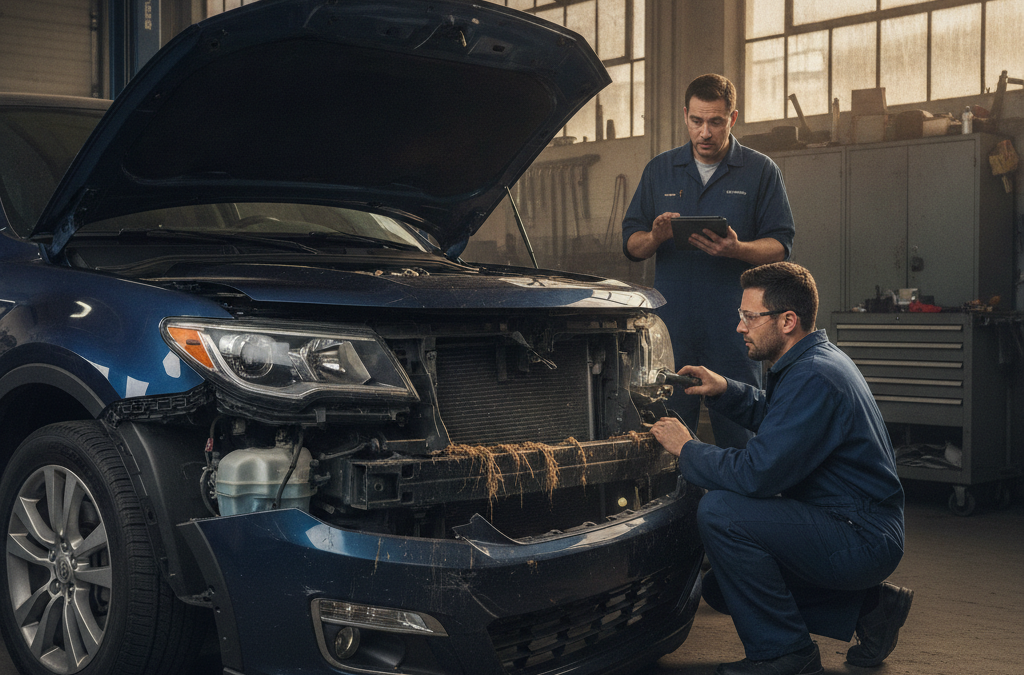
A proper inspection means putting the vehicle on a lift and doing a full teardown of the front end — not just eyeballing it in a parking lot. That’s what a free itemized estimate at a qualified shop should actually include.
Why Certified Repair Matters After an Animal Strike
Animal strikes often affect the front end of the vehicle — which is exactly where manufacturer-engineered crumple zones, sensor clusters, and structural components live. If your vehicle is a Tesla, a Mercedes-Benz, a Subaru, a Toyota, or any other brand where certified repair standards apply, you need a shop that understands those standards and uses OEM-approved procedures and parts.
At S&T Auto Body, our I-CAR Gold Class certified technicians are trained on the latest repair procedures across dozens of manufacturers. That matters because the way you repair a Tesla’s aluminum front structure after an animal strike is fundamentally different from how you repair a conventional steel frame — and doing it wrong can compromise the vehicle’s safety systems entirely. You can review our manufacturer certifications to see the full list of brands we’re certified to repair properly.
If you’re driving an EV — especially a Tesla — this is not a situation where you want to guess at whether the shop has the right training and equipment.
What to Do Right After an Animal Strike
If you’ve just hit an animal and you’re on the side of the road, here’s what to do in order:
- Pull over safely and turn on your hazard lights. Don’t try to move the animal yourself — injured animals can be unpredictable and dangerous.
- Call 911 or local police to report the incident. In New York State, hitting a deer or other large animal should be reported, and having a police report supports your insurance claim.
- Document everything. Take photos of the damage, the animal if it’s safe to do so, your surroundings, and any road signs or landmarks. This documentation matters when your claim is reviewed.
- Call your insurance company to report the claim and confirm your coverage type before agreeing to anything.
- Have the vehicle towed if needed — do not drive a car with potential radiator, structural, or brake damage.
- Choose your repair shop — remember, in New York you have the right to choose your own body shop regardless of what your insurance company suggests.
Frequently Asked Questions: Animal Strike Repairs in the Bronx and Queens
Will hitting an animal raise my insurance rates in New York?
Typically no — an animal strike filed under comprehensive coverage is considered a not-at-fault event and generally does not cause a rate increase in New York. That said, every policy is different. Confirm with your insurer before filing if you’re worried, especially if you have a high deductible that might not be worth filing against for minor damage.
Do I need a police report to file an animal strike claim?
It’s strongly recommended and sometimes required depending on your insurer. In New York State, you should report the collision to the police, especially for larger animals like deer. It creates a paper trail that protects you if anything about the claim is later questioned.
Can I go to any body shop, or does my insurance assign me one?
Under New York State law, you have the right to choose your own repair shop. Your insurance company may recommend or steer you toward preferred shops, but that is your choice to make — not theirs. You are not required to use any specific shop.
My car hit a deer but seems to be driving fine. Do I still need an inspection?
Yes. As described above, significant structural, cooling, and sensor damage can exist without any immediate symptoms. Getting a thorough inspection — including putting the car on a lift — before making a final repair decision is important for your safety and your insurance claim.
What if the damage is on a leased vehicle?
Your leasing company will almost certainly require repairs to be completed with OEM parts and to manufacturer standards. Using a non-certified shop could put you in breach of your lease agreement. Make sure the shop you choose can document the OEM repair process for your lessor.
Get a Free Estimate — No Pressure, No Guessing
At S&T Auto Body, we’ve been repairing vehicles for Bronx and Queens families since 1975. We know how disorienting it is to deal with an unexpected accident, especially one you couldn’t have prevented. Our team will give you a thorough, itemized estimate at no charge, explain exactly what we find, and work directly with your insurance company so you’re not stuck in the middle translating paperwork.
Whether you’re dealing with a cracked bumper or a deer that went under your front axle at 50 miles an hour on the Hutchinson, we’ll tell you honestly what your car needs and what it doesn’t. Contact us today to schedule your free inspection or submit photos of the damage for a preliminary estimate. We’ll get you back on the road safely — and we’ll make sure the repair holds up the way it’s supposed to.